 Fernando de Noronha is an archipelago located off the coast of Brazil and a state district of the State of Pernambuco; the largest island is the one that gives its name to the entire archipelago. Discovered by Vespucci in 1503, it has been a natural park and UNESCO World Heritage Site since 2001, a true paradise for the eyes and senses, with white beaches and transparent waters, caves, marvellous seabed and unspoilt nature. This destination is ideal for those seeking peace and tranquillity. In fact, the entrance is limited and no more than 700 people can stay overnight. Entrance is charged by means of a tourist tax and if you want to spend a holiday in this paradise, you have to budget a fairly high expense. The entire archipelago is considered a luxury destination.
Here is where it is, when to go and what to see
Informed travel: useful info
Inhabitants: 2,630
Capital: Recife
Languages: Portuguese
Local currency: Brazilian Real (€1.00=Real 4.30)
Climate: tropical, warm all year round with stable temperatures. There are two climatic seasons, dry from August to January, rainy from February to July.
Vaccinations: no vaccination required.
Entry requirements: passport with residual validity of at least 6 months. Entry to the archipelago requires registration on the official website, print it out and pay it in cash in Brazil at any post office.
Distance from Italy: 7,190km (approximately 14 hours flight time, with stopover)
Location
On the Atlantic Ocean, about 350 km from Recife, this archipelago is the visible part of an underwater mountain range of volcanic origin. There are 21 islands that make it up, all of which can be visited and are connected to each other, but bear in mind that it takes more than an hour's flight from Natal or Recife to reach Fernando de Noronha airport.
How to get there
From Milan or Rome: there are no direct flights and it is necessary to make two stopovers. From Milan and Rome you can fly to Lisbon and then to Recife with TAP or to Madrid and then connect to Recife with Air Europa. From Recife, connections to Fernando de Noronha are provided by Azul with flights of 1 hour 15 minutes. The journey, including stopovers, can take between 13 and 15 hours. Flights from €614.00 - see offers
From major European capitals: direct connections to Recife are provided from Lisbon with TAP in 7 hours and from Madrid with Air Europa in 9 hours. From London you can fly with TAP and from Paris with Airfrance for a total journey time of around 13-15 hours.
When to go? Info on climate and best time
Month | Average temperatures (min/max) | Precipitation (days/mm) |
|---|---|---|
January | 25 / 30° | 6 / 65 mm |
February | 25 / 30° | 11 days / 110 mm |
March | 25 / 30° | 17 days / 265 mm |
April | 24 / 30° | 18 days / 290 mm |
May | 24 / 29° | 18 days / 280 mm |
June | 24 / 29° | 13 days / 190 mm |
July | 24 / 28° | 11 days / 120 mm |
August | 24 / 28° | 4 days / 35 mm |
September | 24 / 29° | 3 days / 20 mm |
October | 24 / 29° | 1 day / 10 mm |
November | 25 / 30° | 2 days / 15 mm |
December | 25 / 30° | 3 days / 20 mm |
Climate: considering the proximity to the equator, temperatures are high and fairly stable throughout the year and even at night the temperature almost never falls below 20 degrees. The rainy period is from March to June and the dry period from September to December, although thunderstorms are possible.
Thebest time to enjoy the archipelago's natural offerings is from August to January, when sunshine and visibility for diving are guaranteed. For those who enjoy sports such as kiting and surfing, we recommend February and March, when the waves are very high.
Period to avoid: if you want to avoid the rains and not miss a single day of sunshine, April and May are not recommended.
Advice: keep in mind that this is a destination of extraordinary beauty but also quite expensive by Brazilian standards. Even the simplest establishments, bars or restaurants, have really high prices and the use of ATMs and credit cards is not widespread. Bring light, cotton clothes, the inevitable sunscreen and mosquito repellent. The health situation has poor state facilities while private ones are much better. It is difficult, on the islands, to find all kinds of medicines, so if you have particular illnesses, it is advisable to bring what you need from home. Good health insurance is highly recommended.
Which islands to go to?
There are 21 islands in the archipelago, but there are three of note:
Fernando de Noronha: it is the largest island and gives its name to the whole archipelago. Here you will find the most beautiful bays and beaches and the main services, as well as the airport. There are supermarkets, health districts and the tourist office; the accommodation facilities are all of a good standard. More than ten diving spots, varied flora and fauna and courteous inhabitants. Visitable by taxi or by hiring Buggys (small 4X4 open-top cars), it has only one paved road. Excursions to visit the neighbouring islands also depart from here.
Ilha Rata: is the second largest island, but almost totally uninhabited. Reachable by sea with day trips, it is possible to go trekking and bird watching. Famous for diving at Buraco de Inferno, a true paradise for divers. To visit it, a local guide is recommended. There are no services and nature reigns supreme in every corner.
Ilha de Meio: is a very small island between Fernando de Noronha and Ilha Rata and is also almost completely uninhabited. There are no services and few boat moorings, but the seabed is marvellous.
What to see and do: beaches and places of interest
Baia do Sancho: this is one of the most beautiful beaches in the world, if not the most beautiful. On the bay's beach, one can enjoy unspoilt sea and some of the most impressive marine flora and fauna. From January to July, visitors are forbidden because turtles come here to nest.
Cocimba do Padre: is usually chosen by water sports enthusiasts. On this beach you can ride waves up to 5 metres high, snorkel or dive. Not suitable for families with children because of the deep sea and confusion.
Conceiao Beach: famous for the possibility of walking to rocks and reefs at low tide. It is not difficult to meet sharks and fish of all kinds even close to the shore. The beach is very large but usually crowded and there is the possibility of renting umbrellas.
Baia dos Golfinhos: a breathtaking sight with cliffs, tropical vegetation and a beautiful, almost always deserted beach. This beach is suitable for swimming because the waves are small, the currents weak and it is easy to find yourself swimming with dolphins. The beach is wild and offers no facilities such as bars, sunbeds and umbrellas.
Baia do Sueste: shallow water and a child-friendly beach with beautiful vegetation, clear sea and fish swimming to the shore. The small bar at the entrance can be useful, but the beach is not equipped.
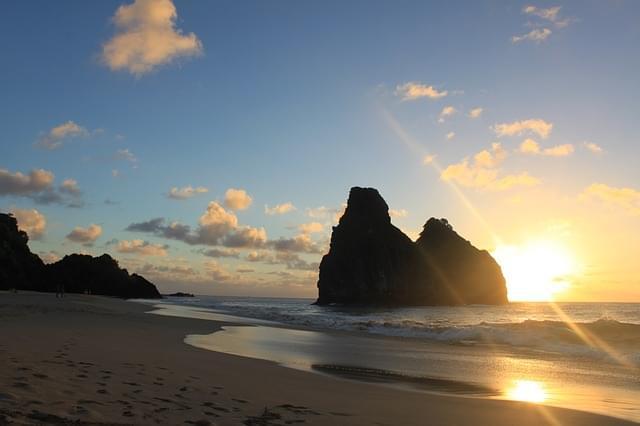
Baia dos Porcos: one of the most impressive beaches because of the intertwining colours of the sea, the sky and the beautiful vegetation that sometimes reaches into the water. Many rock formations, including the much-photographed'Dois Irmaos' rocks, and an absolute ban on any kind of water sport, which means peace and no noise. To get there you have to do a half-hour trek.
Forte dos Remedios: The best preserved of the forts on the island of Fernando de Noronha, the Fort of Our Lady of the Medicines was built by the Portuguese in the 18th century, to fortify the island's defence system, over the remains of a small Dutch fort from 1646. To protect it, 27 cannons were inserted into the perimeter, some of which are still well preserved today.
Fort Sao Pedro do Boldro: the remains of an 18th century fortress are in themselves an excuse to climb up here. Historically and architecturally unimportant, this site does, however, offer a beautiful and evocative view of the bay and many people visit it at sunset to admire the beautiful colours and relax.
How much does a holiday in Fernando de Noronha cost? Prices, offers and tips
 Deciding to spend even just a few days in this paradisiacal natural park involves a high outlay. Return flights to the main island from Recife start at €168.00. The tourist tax (preservation) is around €7.00 per day. There is no shortage of hotels, but prices start at €250.00 per day in a double room with breakfast; cheaper are the posadas, local B&Bs, with daily rates in a double room from €50.00 without breakfast. To eat, the many restaurants offer local cuisine, obviously based on fish, with prices of around €30.00 per person. Flight+hotel packages are offered by Tour2000 from €1,950.00 for 6 nights per person excluding intercontinental flight and by Promobrasil from €850.00 for 3 nights per person excluding intercontinental flight.
Where to stay: Hotels and b&b from €50.00 per room - look at the offers
Low cost flights: from €614.00 - look at the offers
Flight + hotel: 10 days / 9 nights from €2,590.00 per person - look at the offers