If you want to explore an unfamiliar city, nothing beats public transport. Provided that the network is sufficiently extensive and efficient. Unfortunately, not all cities are equal in this respect. While you can get around Paris in no time at all, you will have to be a little more courageous in cities like Los Angeles or Mexico City.
But which city has the fastest public transport in the world? And which has the most sociable network? This is what scientists from the Polytechnic University of Turin in Italy wanted to know. To find out, they carried out an extensive study of public transport performance around the world, the results of which are published in the journal Royal Society Open Science.
During their research, the researchers took into account several parameters in order to evaluate two scores, one associated with speed and the other with sociability. "In simple terms, the velocity score measures the speed of getting from one point to another in a city," the authors explain in their report. "The sociability score measures the size of the population that is able to reach any point in the city.
And the fastest transport is at ....
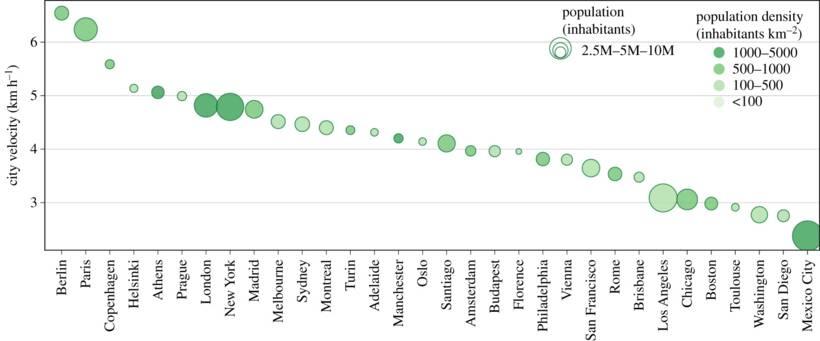
By combining this data with factors such as population density, they were able to generate several rankings, including the cities with the fastest public transport. Berlin came out on top with an average velocity per person of 6.54 kilometres per hour. It is followed by Paris (6.24), Copenhagen (5.59), Helsinki (5.14), Athens (5.06), Prague (4.99) and London (4.81).
At the other end of the scale, Mexico City is the slowest public transport city with 2.38 km/h, followed by San Diego (2.75), Washington (2.75), Toulouse (2.91) and Boston (2.98). In the middle, other cities such as Vienna, whose public network is praised, scores 3.80 km/h.
"This velocity score represents an indicator of the effectiveness of the public service in allowing rapid exploration of the urban space," the researchers explain. "It indicates, for example, that a citizen of Berlin or Paris can generally explore the space at least 20% faster than others.
Conversely, the poor performance of Mexico City or San Diego shows that a whole section of their population is deprived of transport.
By taking into account the second score, another ranking could also be established, that of the most sociable public network. "The sociability of a city is the number of people that a city resident can potentially meet during a daily journey", the authors of the study continue. And it is Paris that takes first place with a score of over 1.2 million people.
The French capital is followed by New York (0.85), Madrid (0.8), London (0.78), Berlin (0.70) and Athens (0.60). "Of all the cities considered, Paris is the only one where a person can meet on average more than one million people in a daily journey," they note.
It is important to note, however, that the list of cities studied remains very limited and does not include, for example, Japan, whose network is nevertheless renowned and very busy.
An interactive map of public transport
The study does not stop at these rankings. The team combined all the data obtained in an interactive map that allows a detailed assessment of the performance of urban transport in the areas studied. The researchers hope that this work will help improve public networks and accessibility in cities.
"The study of accessibility in urban contexts is a multifaceted subject whose interest transcends the simple problem of optimising transport systems, although it is very complex. It impacts the level of opportunities available in a city, the equality of access and the level of inclusion of minorities," the Italian scientists concluded.
READ ALSO
⋙ Germany considers free urban public transport
⋙ Douglas Kennedy: his journey along New York's A line
⋙ Will the underground supplant the car in Qatar?