Abandoned villages, disused dwellings and quiet streets come back to life thanks to Albergo Diffuso. But what are they? They are accommodation facilities with all the comforts of hotels, but designed to enhance ancient dwellings, entire hamlets or old rural buildings. Rooms and flats are scattered around the streets of the village no more than 200 metres from the reception.
Scattered around the streets of the village, the Albergo Diffusi allow people to experience the places as true locals, in harmony with the territory, the people and the culture, for a slow and eco-sustainable journey. Follow us on a tour from the north to the south of Italy to discover the most fascinating alberghi diffusi.
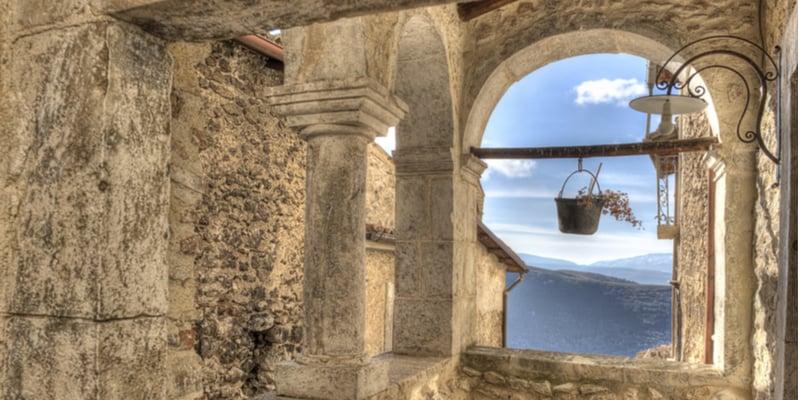
What are Albergo Diffusi?
It is an idea born in Carnia from the need to use empty houses and uninhabited villages for tourism purposes after the earthquake that struck Friuli Venezia Giulia in 1976. The 'albergo diffuso' hospitality model was developed by Giancarlo Dall'Ara, professor of tourism marketing and president of theNational Association of Albergo Diffusi. This model of hotel village, which favours small historic centres, ancient villages and rural or mountain settlements, has rapidly spread throughout Italy but also the rest of Europe.
Part home, part hotel, diffused hotels offer the possibility of staying in ancient dwellings renovated according to traditional architecture or modern design, with a homely atmosphere and authentic charm.

Albergo diffuso hotels in Italy
Friuli Venezia Giulia
The first Albergo Diffuso in Italy originated in Friuli Venezia Giulia, in the Dolomites of the Carnic Hills Park. TheAlbergo Diffuso Forgaria Monte Prat was one of the first. The stavoli of Monte Prat, the typical rural houses made of local stone found on the plateau, were saved from abandonment and today form the rooms of this Albergo Diffuso in a wonderful unspoilt valley.
Period houses, independent and located in ancient hamlets all worth visiting, let guests immerse themselves in the authentic life of yesteryear.
The Friulian Dolomites Natural Park hosts another Albergo Diffuso in the upper Tagliamento Valley in Carnia, in the village of Forni di Sotto. It consists of twelve holiday homes with the typical warmth of mountain chalets, located throughout the village, not far from the central square. The former town hall, recently renovated, is the heart of the hotel and houses the reception, as well as a wellness centre with Finnish sauna, whirlpool and Turkish bath.
Another of Italy's first diffuse hotels is that of Sauris in the Carnie Alps: the stone houses and stavoli that dotted the hamlets of Sauris di Sopra, Sauris di Sotto, Lateis and La Maina are now flats and rooms in a new hotel village. For those who want to treat themselves to a moment of true relaxation, the hotel also has the Ghesunthaus SPA, with Finnish sauna and Turkish bath, and the Grien SPA with swimming pool and whirlpool. The hotel is one of the best known in Italy for relaunching the town's economy and sustainable tourism.

Piedmont
La Locanda degli Elfi is a beautiful albergo diffuso in the upper Maira valley in the unspoilt village of Preit di Canosio. The hotel has rooms and flats that can accommodate up to 6 people, some of which have a panoramic terrace and garden, and finally a junior suite for quiet or sporty weeks. Recently renovated, the rooms emphasise the local architecture, with their slate roofs, stone walls and traditional mountain furnishings of the Piedmontese valleys. It is a family environment where you can indulge in local specialities at its restaurant, which has kept the old name of Mascha Parpaja, the good witch butterfly.
Ask to be told the ancient legend to which the name is linked. The hotel also has a cave spa with sauna, whirlpool and chromotherapy. Activities such as traditional dance classes, skiing and alpine excursions are also organised.
Veneto
Casa Burano is the ideal diffused hotel for those who want to live like a local. Burano, the magical island of colours in the Venice lagoon. Thirteen rooms are located in five enchanting, colourful cottages, renovated with modern comforts and avant-garde design. Staying on the island means discovering the authentic Burano as told by the people who live there, such as Paola the lacemaker, Maurizio the rower, Bruno the ortolan and Carmelina the bussolaia, who every morning bakes the typical Burano sweets, the bussolà. There are various experiences to be had in the company of the locals: you can set off on a trip on a bragozzo, a typical lagoon fishing boat, to Torcello with an aperitif on board, visit the vineyard and taste the Venissa wine, or you can try rowing the Venetian way and discover the wild herbs to be used during a mixology master class.

Tuscany
In Cinigiano, one of the best-preserved villages in Tuscany, is the luxury hotel diffuso Castel Porrona, a medieval castle on the hills that slowly slope down to the sea from Montalcino. Built in the 12th century, the castle belonged for five centuries to two of the greatest families of the Sienese nobility, the Tolomei and the Piccolomini. All the elegant rooms and suites of Castel Porrona are within the original medieval complex, furnished in rustic Tuscan style with retro details and fine fabrics. The Il Chiostro restaurant offers seasonal Tuscan cuisine, the outdoor swimming pool moments of relaxation with views of the Tuscan hills, and the luxurious spa with its arabesque atmosphere an escape into the fairytale world of the Thousand and One Nights.

Abruzzo
In Abruzzo is Sextantio, a charming albergo diffuso in the medieval fortified village of Santo Stefano di Sessanio. The village is located in the mountains of Abruzzo within the Gran Sasso and Monti della Laga National Park.
Today, an Albergo Diffuso stands here, the result of a cultural project aimed at recovering and transmitting the identity culture of the area in which it is located. The services offered are linked to the local cultures, from domestic customs to popular food and handicrafts, brought to light by ethnographic research conducted over the last ten years with the Museo delle Genti d'Abruzzo. You can choose between the La Cantina room, the L'Alchimista suite, the Rooms on the Corte or the Pineta. The restaurant La Locanda sotto gli archi offers traditional Abruzzo cuisine served on ceramic plates amidst pre-20th century wooden tables and benches. The Bottega dell'Artigianato recreates the domestic space traditionally lived in by women, with the large loom in the centre. The hotel also offers the opportunity to participate in activities such as climbing, hang-gliding and horse riding.

Campania
In the heart of Irpinia and the Monti Picentini Regional Park lies the albergo diffuso Borgo di Castelvetere sul Calorea suggestive casket that preserves several churches linked to the cult of the Madonna delle Grazie, the ancient oratory and an underground room where the bodies and clothes of plague victims from the 17th century are preserved. The Albergo Diffuso has 17 lodgings with traditional architecture that can accommodate up to 8 people in single or double rooms, a characteristic restaurant where you can discover typical Irpinian recipes and taste local wines such as Greco di Tufo, Fiano di Avellino and Taurasi, a shop selling typical products and local handicrafts, as well as conference and entertainment rooms scattered among the village's small squares and alleyways.
Puglia
Amidst centuries-old olive trees, vineyards and the scents of the Mediterranean maquis stand 42 trulli, witnesses to an ancient rural village that in the mid-19th century may have provided shelter and hospitality to Basilian monks and later peasant families. Not far from the historic centre of Cisternino in the Itria Valley, stands Borgo Canonica born from the renovation and recovery of a rural hamlet dating back to 1800, consisting entirely of trulli, in an area of six hectares.
The skilful recovery of all the elements of the place, such as the ancient ovens, historic cisterns and dry-stone walls, will help you rediscover the authenticity of life in the past. The hotel consists of several charming dwellings in trulli with all the comforts of a rural relais, equipped with a swimming pool, green areas with lounges, reception and breakfast room.
In the white village of Locorotondo, a small jewel of the Itria Valley and one of the most beautiful villages in Italy, is the Sotto le Cummerse albergo diffuso, named after the typical sloping roofs characteristic of the town. Spread among the white alleys of the village are the elegant flats that Angelo Sisto and his wife Teresa Salerno have renovated in the traditional style. La Salottina is the space used for breakfast and gourmet dinners. At the ciclofficina you can rent bikes to explore the Itria Valley.

Basilicata
The Sextantio diffused hotel in Santo Stefano di Sessanio also has its premises in Matera: Grotte della Civita. The hotel is located in the oldest area of the European Capital of Culture 2019, set in the rock caves. There are 18 rooms, almost all inside caves, with minimalist furnishings. For a special night, book Grotta 13, better known as the Bridal Suite, is the only one to extend over several levels divided between a sleeping area with a large window and balcony with a panoramic view of the Murgia Park, a living room and a bathtub located in a romantic exclusive grotto with a fireplace. If you really want to relax, book a massage in your room. In the mornings, breakfast is served in the communal grotto, an ancient cave church from the 13th century, which is lit with many small candles for dinner.
Between the background of classical music and a lit fireplace, the ancient grotto becomes a fairy-tale setting for a winter dinner. The outdoor terrace, on the other hand, is the ideal place for a summer aperitif contemplating the Murgia Materana.
But Matera also reserves many other popular hotels such as the Sant'Angelo Luxury Resort which has 23 historic dwellings, ancient stone caves now transformed into refined suites with modern furnishings, set in the tuff, among narrow streets, steps and courtyards in the scenic amphitheatre of the Sassi of Matera. Or the hotel Corte San Pietrowhose rooms are houses restored to recreate an ancient Lucanian village. Among these, Civico 16 is the grand suite, a large room in a cave with a bathroom excavated in the tuff and a stone bathtub.
Between Matera and the Ionian coast of Basilicata lies Il Borgo Ritrovato, the albergo diffuso in the village of Montescaglioso. Ancient dwellings and craft workshops have been renovated and converted into cosy rooms and flats with all comforts. The day begins with local flavours and old home recipes.

Sicily
The Resort Borgo San Rocco takes its name from the village of Savoca of the same name, 20 km from Taormina. It is situated between the churches of S. Nicolò and S. Maria in Cielo Assunta like an elegant and refined casket. Its 21 elegant rooms have been carved out of old fishermen's dwellings from the turn of the century and are built around the main core that houses the reception, lobby and restaurant.
Further south, near Modica, is theAlbergo Diffuso of Scicli, a precious testimony to Sicilian Baroque art in the Val di Noto. The hotel is located in the historic centre of Scicli, a Unesco World Heritage Site, and offers guests two types of accommodation: hotel rooms and small independent flats.
An excellent base from which to explore south-eastern Sicily.

Sardinia
In Sardinia, too, the Albergo Diffusi will let you discover the life of the Mannois, which in Sardinian means ancestors. In Orosei you will find Mannoisthe albergo diffuso in the heart of eastern Sardinia, a few steps from the sea and the nuragic villages. The hotel offers all the comforts of a 4-star hotel and 50 rooms of different types in renovated historic houses, scattered among stone alleys, small courtyards and wonderful views. The reception is located in the Su Rosariu mother house, a few steps from Piazza del Popolo, the main square of the village. The hotel also offers guests the terrace restaurant Locanda Sa Turre and the Mannois Beach Club, the hotel's private beach at Marina di Orosei. Finally, the hotel offers various types of bicycles for excursions in the unspoilt nature.
On the north-western coast of Sardinia, in the heart of Bosa, an ancient pastel-coloured village overlooking the river Temo, lies Corte Fiorita. It consists of several historic buildings and manor houses, a few dozen metres apart, housing 30 simple rooms of different types. On the opposite bank, the old tanneries have become four junior suites. Corte Fiorita can be an excellent starting point for exploring the historic centre of the Sardinian village, the picturesque coastline, the valley of Bosa with its famous Malvasia Road and the quiet paths through the vineyards and Mediterranean scrub.
Italy
Related articles
From Berlin to Rome: a walk along the walls of history
Where to Go in Autumn 2024: Holiday Destinations in Italy and Europe
11 Strange and peculiar farmhouses and hotels in Italy
Cycling routes in Italy: maps and itineraries
Hotel Castellana, Venice, Italy

Where to sleep in New York? Opinions and advice on 5 tested hotels
Hotel Claridge , Madrid - Spain