My favourite attractions: the top 5 at a glance
 The Isola dei Pescatori is a true picture book in Lake Maggiore
Chillon Castle on Lake Geneva
Triftbrücke bridge
Ruinaulta (Rhine Gorge)
Bernina Express
Zurich
By the way, Switzerland is one of the best countries to emigrate to.
1. Lake Maggiore
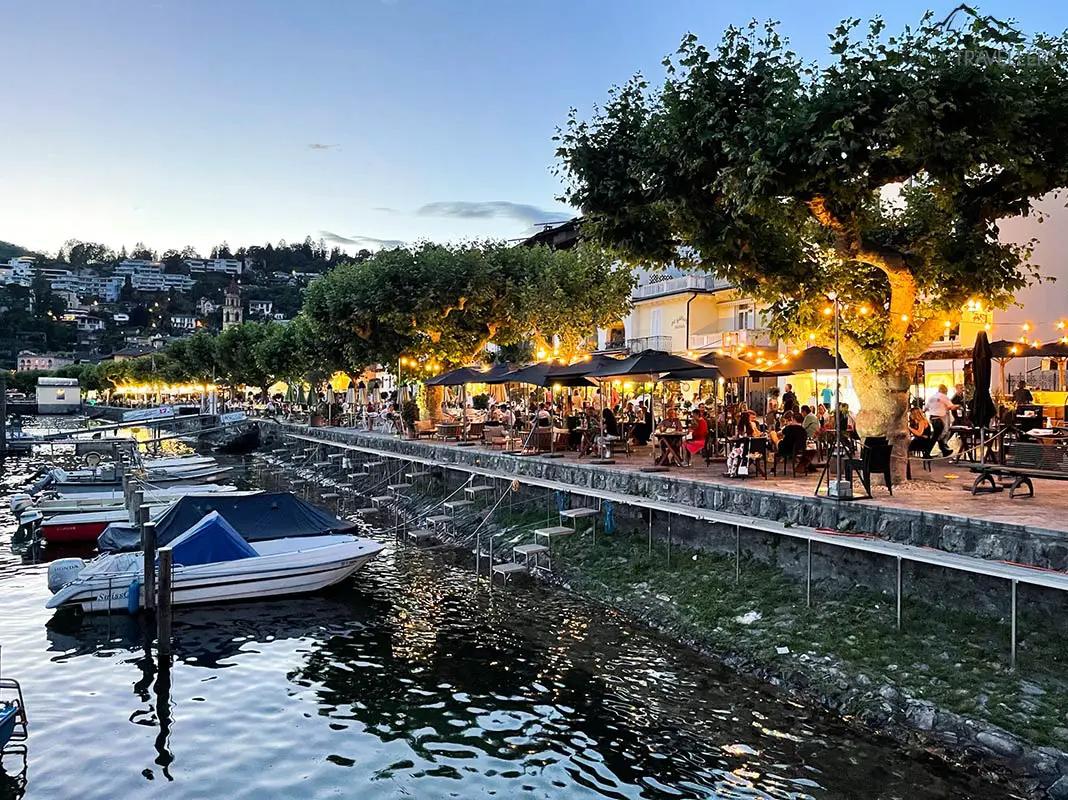 Ascona is one of the most beautiful places on Lake Maggiore. In the evening the harbour promenade fills with people.
We start this list with Lake Maggiore or Lake Maggiore. It starts in the very south of Switzerland and then stretches into Italy for the most part. You probably know Lake Maggiore by the name Lago Maggiore.
Even though only about 20 percent of the lake lies in the Swiss canton of Ticino, there are many great sights on this northern shore. These include, for example, the famous pilgrimage church of Madonna del Sasso, which is located above the town of Locarno.
 This is the view of Lake Maggiore in the evening when it rains. But what does a little rain matter when it's a balmy 27 degrees?
In our article on the 7 most beautiful places on Lake Maggiore you'll find all the details! There you will also rediscover the Verzasca Valley, which I will tell you more about now.
Tip: Lake Maggiore is not the only beautiful lake in Switzerland. You'll discover a few more in this article! Lake Lugano(Google Maps), for example, which also stretches into Italy, did not make it onto the list. But the lake and the beautiful town of Lugano are still worth a visit!
2 Verzasca Valley
 The Ponte Dei Salti is one of the most famous sights in Switzerland.
The Verzasca Valley, or Valle Verzasca in Italian, lies not far from Lake Maggiore in the Swiss canton of Ticino and is one of the most beautiful valleys in the region.
Here you will find pure idyll - fairytale rocky landscapes, picturesque mountain scenery and romantic villages. The so-called rustici, spectacular old buildings made of grey stone, are also exciting.
The valley is flowed through by the river of the same name, the Verzasca, which finally flows into Lake Maggiore. The emerald-green waters of the river are pleasantly refreshing, earning it the nickname "Switzerland's Maldives".
Probably the most popular and best-known photo motif in the Verzasca Valley is the historic arched bridge Ponte dei Salti, under which the Verzasca flows. You can look forward to a truly dreamlike sight at this sight.
The Verzasca Valley is also particularly attractive for mountain hikers. The many peaks, beautiful huts, steep slopes and pristine waterfalls make the region a unique experience. There are various hiking trails with varying degrees of difficulty, for example the Sentierone Valle Verzasca, the difficult Via Alta della Verzasca (VAV) or the long-distance Trekking 700, which leads through the Verzasca Valley on the fourth to sixth stages.
The ultimate thrill, on the other hand, is offered by the 220-metre-high Verzasca dam. It was from here that James Bond plunged into the depths in the film "GoldenEye". Even today, the brave can still take the bungee jump and be rewarded with 7.5 seconds of free fall in an incredible setting. Do you dare?
Tip: Speaking of spectacular dams - the Grande Dixence dam(Google Maps) near the Matterhorn is also super exciting. The turquoise-blue melt water from 35 glaciers meets a 200-metre-thick and 285-metre-high wall here. The panoramic view from this record-breaking dam is breathtaking!
3rd Matterhorn
 Here we were snowshoeing on the Matterhorn - an unforgettable experience.
I mentioned it briefly just now - the Matterhorn. The striking pyramid-shaped mountain on the Italian border is considered the landmark of Switzerland.
The Matterhorn reaches a total height of 4478 metres, making it one of the highest mountains in the Alps. However, only experienced mountaineers should dare to make the ascent. All others can observe the majestic natural wonder from a distance - in fact, the Matterhorn is one of the most photographed mountains in the world.
Besides mountaineering, the most popular sports on the Matterhorn are hiking, skiing and climbing. Another little fun fact on the side: the mountain's striking pyramid-shaped summit head served as the model for the famous Toblerone.
 The Matterhorn is one of the most striking mountains in the world
Incidentally, the highest cable car station in the Alps is also located on the Matterhorn at 3820 metres, which you can reach from Zermatt. The car-free town is one of the most famous Alpine holiday destinations in Europe and the ideal starting point for all activities around the Matterhorn. There is even a Matterhorn Museum there!
⭐ Recommended travel guides for your holiday in Switzerland
Switzerland shows itself from its best side in these tried and tested travel guides. It's worth taking a look!
4 Chillon Castle on Lake Geneva
The medieval moated castle is situated on a rocky island and juts picturesquely into the lake. Together with the imposing mountain backdrop, the view is truly dreamlike. The Château de Chillon is therefore even the most visited historical building in Switzerland!
The stone castle was built about 1000 years ago, but it only got its current appearance in the 13th century by the Savoy dynasty. Today you can visit the castle and attend concerts and other cultural events.
By the way, Lake Geneva is also extremely worth seeing in other ways. You can go swimming, diving, pedal boating, canoeing and even kite surfing or wakeboarding.
On the opposite shore of Lake Geneva, in the very west of Switzerland, lies the eponymous city of Geneva. This unique city is home to the headquarters of the United Nations in Europe, French-influenced gastronomy, exciting artists' quarters and a great old town, among other things. Other beautiful places along Lake Geneva include Montreux and Lausanne.
Tip: If you like water castles, you shouldn't miss Oberhofen Castle. It also dates from the 13th century and is located on the beautiful Lake Thun in the Swiss canton of Bern(Google Maps).
 Chillon Castle is one of the top sights in Switzerland - Photo: Evren Türker
5. Jungfraujoch
One of the most popular destinations in Switzerland is the Jungfraujoch. It is located in the middle of a striking triumvirate in the Bernese Alps, consisting of the Mönch, Eiger and Jungfrau mountains.
At 3466 metres, the Jungfraujoch may be the lowest point in the ridge connecting the Mönch and the Jungfrau, but it is also home to the highest railway station in Europe. The best way to get there is to take the Jungfrau Railway, an electric rack railway that has been in operation since 1912, or the modern cable car called the Eiger Express.
Once you've reached the top, you'll find yourself on the Top of Europe. Attractions and highlights await you here, such as the viewing terrace of the Sphinx Observatory and the Ice Palace, which has been carved into the glacier ice since the 1930s. Amateur mountaineers can also venture on the hike to the Mönchsjochhütte.
Quite apart from that, the view from the Jungfraujoch is of course a dream. That's why there's a viewing and adventure platform at 3454 metres, from which you can enjoy the majestic backdrop of ice, snow and rock with breathtaking distant views.
You can find all the information about the Jungfraujoch in our separate article. Our visit was incredible.
Tip: The Jungfraujoch is one of the main components of the Swiss Alps Jungfrau-Aletsch UNESCO World Heritage Site. This includes attractions such as Lauterbrunnen (also known as the Valley of 72 Waterfalls) and the picturesque Lake Oeschinen with its beautiful turquoise waters. The other main component of the World Heritage Site is the Aletsch Glacier, which we now continue with!
6 Aletsch Glacier
At just under 23 kilometres, the Great Aletsch G lacier is the largest and longest glacier in the Alps in terms of area.
You can compare the Aletsch Glacier with a five-lane motorway of the same length. However, climate change is also taking its toll on it: the glacier is losing about 50 metres a year.
From the viewing platform on the Jungfraujoch you already have a great view of the upper part of the Aletsch Glacier. Even more spectacular is the view from one of the cable cars that run between the Riederhorn and the Eggishorn and also open up views of the lower part and the tongue area of the glacier.
For the brave, I can definitely recommend a guided glacier tour. Here you explore the Aletsch Glacier up close with an experienced mountain guide and get truly unique and impressive insights.
Tip: Another spectacular sight in Switzerland is the ice grotto in the Rhone G lacier(Google Maps), sometimes also called the Rotten Glacier. Here, accessible ice tunnels and ice chambers have been cut into the glacier every year since 1870.
7 Gotthard Pass
We stay in the mountains and take a look at the Gotthard Pass. It crosses the border between the two cantons of Uri and Ticino and is one of the most important north-south connections in the Alps.
The Romans were already familiar with the route and the pass road was also much used in the Middle Ages. Today, the picturesque route with its many serpentines and breathtaking mountain panorama is a tourist highlight in itself for many - the journey becomes the destination here.
Incidentally, shots of the Gotthard Pass from the air are particularly impressive. An exciting sight along the road is the old and the new Devil's Bridge in the Schöllenen Gorge. A historic and a modern construction blend seamlessly into the rocky landscape here and offer a great photo motif.
If you are interested in the history of the Gotthard Pass, you should also visit the St. Gotthard Museum.
Tip: You can get a great view of the Gotthard massif from another mountain pass. And you should know the Furka Pass(Google Maps) anyway, especially if you're an Instagrammer. This is where you'll find a famous and extremely popular photo motif: the Hotel Belvédère, which is perfectly embedded in the winding road.
8 Trift Bridge
An absolute must-see in Switzerland is the Trift Bridge. This pedestrian rope bridge was built according to a construction method from Nepal and is 170 metres long.
At a height of 100 metres, it crosses the Trift Gorge and the so-called Trift Water, a fascinating turquoise glacial lake. This makes the Trift Bridge one of the longest and highest suspension rope bridges in the Alps!
You can reach this sight comfortably in one of the gondolas of the Triftbahn. From the mountain station, you can also tackle a great hike directly to the Windegg Hut.
Great Instagram photos are inevitable here. Definitely a good reason to visit Switzerland, don't you think?
9 Ruinaulta (Rhine Gorge)
We continue with the Grand Canyon of Switzerland: the Rhine Gorge or Ruinaulta. The name is a combination of the Rhaeto-Romanic words "Ruina" for scree or quarry and "aulta" for high.
That's apt, because the Ruinaulta is a 13-kilometre-long and up to 400-metre-deep gorge. It was formed about 10,000 years ago by the Flims landslide. At that time, more than 10 billion cubic metres of rock broke off and buried the valley underneath, whereupon the river had to make its way through the debris.
Today you can marvel at a unique play of colours. The white rock formations, the turquoise Vorderrhein and the green nature are simply breathtaking.
The best way to explore the Ruinaulta is on one of the many hiking trails that lead to numerous great viewing platforms. For those who don't want to walk so much, there is also a railway whose route runs along the river. The brave can take part in a rafting tour instead.
Tip: Other picturesque gorges in Switzerland include the once infamous Viamala Gorge(Google Maps) and the Trient Gorge(Google Maps) with its waterfall in the Mont Blanc massif.
10. Swiss National Park
Now I'd like to show you Switzerland's only national park so far. In Rhaeto-Romanic it is called Parc Naziunal Svizzer and has set itself three goals: Nature conservation, research and information.
With an area of around 170 square kilometres, the Swiss National Park is the largest nature reserve in the country. One third of this area is covered by forest and one fifth by alps and meadows.
The park was founded in 1914, which makes it the oldest national park in the Alps and the whole of Central Europe. It's a great place to go hiking and admire the unspoilt landscape and the many animals up close.
Incidentally, the Swiss National Park belongs to the Engadine, a high valley in the Swiss canton of Graubünden and one of the highest inhabited valleys in Europe. In the Lower Engadine municipality of Zernez you will also find the National Park Centre.
11. Bernina Express
If you're not much of a hiking fan but still want to explore Switzerland, here's a tip for you. It's about the Bernina Express.
Under the motto "From the glaciers to the palm trees", it crosses the Alps and travels from Chur in Switzerland to Tirano in Italy. The first part of the route is the Albula Railway to St. Moritz, from where it continues on the Bernina Railway.
Both sections of the BEX, as the Bernina Express is often abbreviated, have been UNESCO World Heritage Sites since 2008. On the four-hour train journey, you travel 144 kilometres, pass through 55 tunnels and cross 196 bridges. Probably the most famous is the Landwasseraqueduct in the canton of Graubünden - when the BEX passes over it, you can't help but think of the Hogwarts Express.
But these are not the only sights to see during the Alpine crossing with the Bernina Express. You can expect breathtaking glacier and mountain landscapes, idyllic Alpine villages, unique cultural monuments and a true enjoyment of nature throughout the journey. And the panorama cars of the BEX open up the perfect view of it all.
Tip: Other tourist highlights of the Rhaetian Railway are the Gotthard Panorama Express and the Glacier Express. You can also find the latter in our article Holiday without a plane!
12 Lucerne on Lake Lucerne
We have now arrived in the heart of Switzerland. Here lies Lucerne, one of the most beautiful cities in the country with many sights. We show them to you in the article about the 13 most beautiful places in Lucerne!
Lucerne's landmarks include the beautiful old town with its narrow, historic streets and above all the Chapel Bridge, the oldest wooden bridge in Europe. Next to it is the Water Tower - also one of the most popular attractions here.
The Jesuit Church, the Town Hall and the Rathausquai complete the great panorama. Don't miss the Lion Monument, which depicts the dying lion of Lucerne and is a memorial to the Swiss who fell in Paris in 1792.
 Lucerne on Lake Lucerne
One of the absolute highlights is Lucerne's location on Lake Lucerne. It offers the ideal combination of mountain scenery, swimming and strolling. A boat trip is also a must here.
The best view of the lake, however, is from Mount Pilatus, Lucerne's local mountain and, according to legend, the final resting place of Pontius Pilatus. You can reach the summit with numerous mountain railways.
 The mountain station on Mount Pilatus
Incidentally, the name of Lake Lucerne comes from the fact that it stretches over no less than four cantons. These were formerly known as Waldstätten.
 The Chapel Bridge at sunset in winter in Lucerne
13 Basel
In the border triangle of Switzerland, Germany and France lies Basel, Switzerland's third-largest city and cultural capital.
Cultural capital because there are almost 40 different museums throughout the canton. Contemporary architecture is also of great importance, as you can see projects by a total of 12 Pritzker Prize winners here, for example by Frank Gehry or Renzo Piano.
 Basel by night - Photo: Evren Türker
Moreover, the University of Basel, founded in 1460, is the oldest in Switzerland and one of the oldest in Europe. Thus, historic buildings from the 15th century and modern international architecture form a unique cityscape in Basel.
Other sights include the Basel Minster, the old town with the town hall, the Mittlere Brücke as one of the oldest Rhine crossings and the Spalentor, one of the old city gates. The Tinguely Fountain, the Basel Exhibition Centre and the Augusta Raurica Archaeological Park with a Roman theatre are also absolutely worth seeing.
 Basel by night - Photo: Evren Türker
14th Rhine Falls

The next stop is one of the most popular sights in Switzerland. Moreover, the Rhine Falls is actually one of the three largest waterfalls in Europe.
With a height of 23 metres and a width of 150 metres, it offers a truly impressive natural spectacle and brings back memories of Niagara Falls in Canada.
The best view of the thundering waterfall is offered by several viewing platforms on both sides of the Rhine. Boats also sail into the Rhine Falls basin, departing for example from Schlösschen Wörth in Neuhausen.
Some Rhine Falls tours also take you to Schloss Laufen, which is perched on a rock on the Zurich side and is used as a youth hostel, among other things. There are also several trails around the waterfall, such as the adventure trail (for which a fee is charged), the small circular trail (3.4 kilometres) and the Rhine Falls circular trail (7.2 kilometres).
The area is also great for cycling (which is called Velo here, by the way). If you are particularly brave, you can also rent a kayak or visit the Adventure Park. In the evening, the Rhine Falls are also an absolute highlight: they are sometimes spectacularly illuminated.
As you can see, despite its name, this attraction is definitely not a flop!
 Well, would you dare to stand here directly above the thundering Rhine Falls? In any case, you'll get pretty wet
15 Davos
The town of Davos in the canton of Graubünden in the Swiss Alps is famous. Every year, politicians from all over the world meet here for the World Economic Forum (WEF). Therefore, at least once a year, the town is THE media centre par excellence.
However, Davos is also a well-known climatic health resort. Since the 19th century, the rich social classes have travelled to Davos to relax in the famous world spa. See and be seen was the motto here.
 View over Davos in winter
Today Davos is also a popular skiing El Dorado. The best-known ski areas are Jakobshorn, Pischa, Rinerhorn and Parsenn. Extreme sports enthusiasts can take part in the Swiss Alpine Marathon. It is the highest ultra-marathon in Europe.
A walk along Lake Davos is particularly beautiful. Water sports enthusiasts get their money's worth here and go sailing or motor boating. The famous Glacier Express panoramic railway also departs directly from Davos. Its destination: the Matterhorn.
Davos Klosters is also the highest town in Europe. Doesn't that sound like a top sight to visit?
 Lake Davos in winter
16 Zurich
Now all those who waited until the end for the largest city in Switzerland - Zurich- can breathe a sigh of relief.
The metropolis is considered one of the cities with the highest quality of life in Europe and offers a financial centre, hip cultural offerings and a wild nightlife in addition to a fantastic old town. Here's a tip: be sure to visit the new trendy district of Zurich West!
 Impressions of Zurich
You must also relax by Lake Zurich (known locally as Zürisee) and visit the city's landmark, the Grossmünster. The viewing platform of the famous church also offers one of the best views of Zurich.
Other places of interest in Zurich are the shopping mile Bahnhofstrasse or the main square Bellevue with the Opera House and the Café Odeon. Find out all this and much more at the top 15 attractions in Zurich!
Tip: Other exciting Swiss cities whose sights are definitely worth a visit are, for example, the winter paradise of St. Moritz(Google Maps), medieval Bern(Google Maps) or the somewhat lesser-known Interlaken(Google Maps), the adventure capital of Switzerland.
 View of the tower of St. Peter in Zurich
Tips for your holiday in Switzerland
Before you book your holiday in Switzerland, be sure to check out our post with the most important tips for your holiday in Switzerland!
There we show you the most popular regions of Switzerland, a quick overview of the most important sights and other useful tips such as the ideal time to travel. Traditional holidays, regional festivals and culinary highlights are also included.
 View of Basel in beautiful Switzerland - Photo: Evren Türker
Unusual overnight stays in Switzerland
There are so many great places to stay in Switzerland that there's no way I can name them all here. That's why I'm showing you a small selection of the most unusual places to stay!
Whitepod Eco-Luxury Hotel(check prices here*) - Individual luxury pods that look like igloos on wooden platforms at 1,400 metres above sea level.
Chetzeron(check prices here*) - Former cable car station with views of the Matterhorn, converted into a unique mountain hotel
Igloo Village Zermatt(website) - Stay in real igloos at the foot of the Matterhorn
Yeti's romantic alpine huts(website) - Quaint, idyllic and cosy. Or, as the owner says: Ikea- & China-free zone.
Hotel Castell(check prices here*) - Castle complex in the mountains above the Engadine village of Zuoz, including art exhibition.
Himmelbett: das Thurgauer Bubble-Hotel(website) - four-poster beds in transparent, furnished spherical tents at various locations in Thurgau
Fischer's Fritz Camping(website) - camping site with beach and other great offers, for example an aluminium caravan or a safari tent, on Zurich's lakeshore
Cabanes perchées Les Nids(website) - Means "tree houses The Nests" and consists of four glassed-in tree houses at a height of 5 to 8 metres.
InterContinental Davos(check rates here*) - located above Davos with a magnificent view of Davos, a heavenly wellness area and pure luxury
 The Hotel InterContinental in Davos impresses with its luxury
Facts and figures
Switzerland consists of 26 partly sovereign cantons, similar to the federal states in Germany.
The eight largest cities or economic centres in Switzerland are Zurich, Geneva, Basel, Bern, Lausanne, Winterthur, Lucerne and St. Gallen
The Swiss registration number CH comes from the Latin term "Confoederatio Helvetica" - this should not give preference to any of the country's four official languages
More than half of the Swiss speak German - more precisely Swiss German or Schwizerdütsch, which belongs to the Alemannic dialects
I hope you enjoyed my sights in Switzerland. I'm curious to know which region you will visit, or if you are even planning a road trip through Switzerland? Have fun exploring one of our neighbouring countries