15 particularly historic places in Germany
These unique historical places in Germany are more than worth seeing:
Technical Museum U 995
Berlin Wall Memorial
Pömmelte Ring Shrine
Monument to the Battle of the Nations
Wartburg Castle
Aachen Cathedral
Government Bunker Documentation Centre
St Michael's Chapel
Documentation Centre Nazi Party Rally Grounds
Dachau Concentration Camp Memorial
Dietfurt Ruin
Otzenhausen ring wall
Eagle's Nest
Peenemünde Historical-Technical Museum
Zollverein Colliery
1st Technical Museum U 995
Our round trip begins in the far north. On a beach north of Kiel lies a long, grey and seemingly stranded boat. It is the submarine U 995, built in 1943 and used by German soldiers against enemies in the North Sea during the Second World War.
After the war, it served the Norwegian Navy as a test and training boat and returned to the possession of the German Navy in 1965 as a sign of reconciliation. In 1972, the submarine was set down at the foot of the naval memorial in Laboe in an elaborate operation and has been a historical-technical museum of a special kind ever since.
Visiting the boat is not for people who suffer from claustrophobia: It is an oppressive feeling to squeeze through the stuffy rooms and imagine how soldiers lived here for weeks in a confined space.
As a memorial, U 995 reminds us of the suffering in the Second World War on both sides. In the German navy, about 30,000 of the more than 40,000 submariners died.
All info:
Address:
Strandstraße 92, 24235 Laboe (Google Maps)
Opening hours:
April to October daily 9am to 6pm, November to March 10am to 4pm, 24 and 31 December 10am to 2pm.
Admission:
5 euros for adults, reduced 4 euros.
 The U-995 technical museum is one of the most exciting places in Germany.
2nd Berlin Wall Memorial
 The East Side Gallery in Berlin is one of the most important historical sites in Germany
On your journey into Germany's past, a visit to the Berlin Wall Memorial is a must. It stretches over 1.4 kilometres along the former border strip and is the symbol of the division of Germany. Between 1961 and 1989, part of the Berlin Wall was located on Bernauer Strasse and became the site of dramatic escape attempts to West Berlin.
Today's site includes a 70-metre-long original piece of the Wall as well as exciting exhibitions. Here you can get an impression of the former border fortifications and learn about the history of division and the lives of people on both sides of the Wall.
The memorial at this historic site shows you that just over 30 years ago, the Wall stood where you are now and shaped the fates of entire generations. It is one of the top sights in Berlin.
3 Pömmelte Ring Sanctuary
About 4,300 years ago it was an important cult site and still fascinates people today: the Pömmelte Ring San ctuary in Saxony-Anhalt. Like the English Stonehenge, it was built at the end of the Stone Age and served people for centuries as a sanctuary, sacrificial site and burial ground. Apart from rituals, various festivals were also celebrated here throughout the year.
The ring sanctuary was discovered in 1991 and researched and excavated from 2005 to 2008. The reconstructed site comprises seven rings of wooden piles, pits and ramparts and is impressive in its size. Embark on an exciting journey through time and experience the cult site up close!
To round off your visit, you can also visit the Salzland Museum in the nearest town, where many original finds such as axes, ceramic vessels and grinding stones give you an impression of the background of the cult site.
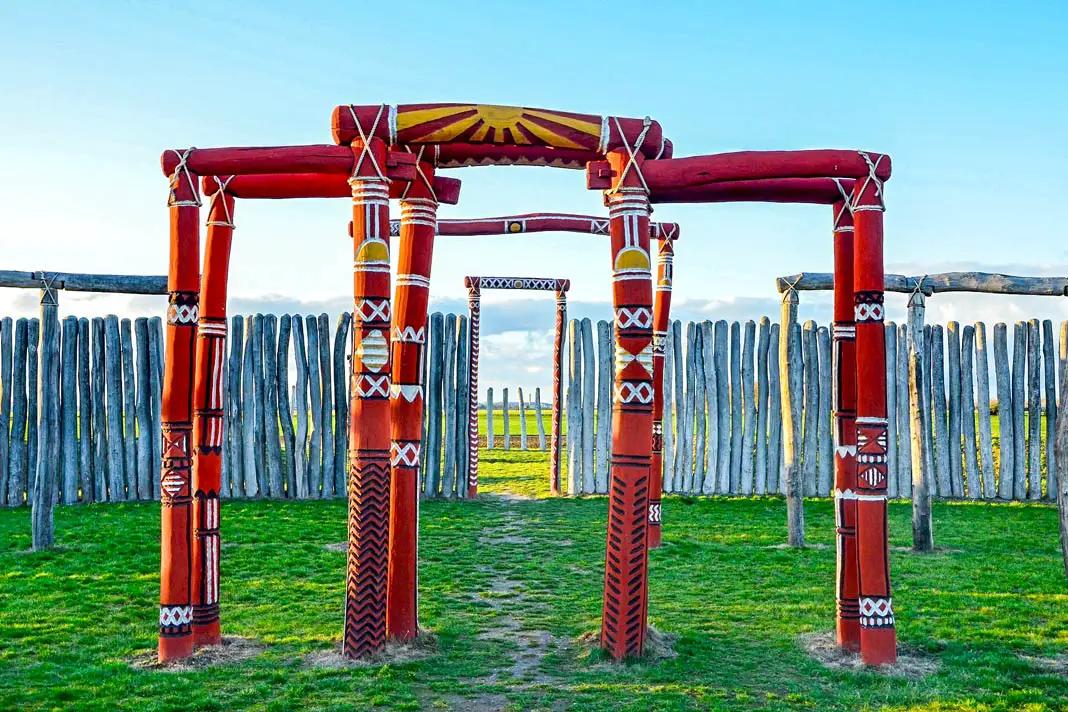 The Pömmelte Ring Sanctuary
Recommended travel guides for history buffs
If you are now gripped by history fever, the following travel guides are just the thing to help you discover more mysterious historical places in Germany.
4 The Monument to the Battle of the Nations
The tour continues in the south-east of Leipzig. Here, an imposing monument commemorates the Battle of the Nations of 1813, considered the first major battle in human history, which took place just outside the city gates. The troops of Russia, Prussia, Austria and Sweden defeated Napoleon and his allies. The bloody battles and the spread of epidemics cost the lives of more than 110,000 people.
 The imposing Monument to the Battle of the Nations is one of Leipzig's top sights and is famous far beyond the city's borders.
To honour the fallen, the Monument to the Battle of the Nations was inaugurated on the 100th anniversary of the battle in 1913. With its 91-metre height and its reflection in the water basin in front of it, it still leaves a lasting impression today. Don't miss the monumental Hall of Fame with its equestrian dome, huge statues and crypt.
Another highlight is the viewing platform, from where you have a great view of Leipzig and its surroundings. At the foot of the monument is the FORUM 1813 museum, which tells you everything you need to know about the background to the Battle of the Nations. The Monument to the Battle of the Nations is one of the top sights in Leipzig.
All info:
Address:
Straße des 18. Oktober 100, Leipzig (Google Maps)
Opening hours:
April to October daily 10am to 6pm, November to March daily 10am to 4pm.
Admission:
8 euros for adults including museum visit
5 Wartburg Castle
 Wartburg Castle in Thuringia was even the model for Neuschwanstein Castle in Bavaria.
Germany's best-known and most historic castle towers above the Thuringian town of Eisenach: Wartburg Castle. The Thuringian landmark is considered a national monument and is a contemporary witness to almost 1000 years of German history - the castle was founded as early as 1067. Wartburg Castle experienced its artistic heyday around 1200 as the seat of Landgrave Herman I, who made it the capital of German poetry. It is one of Germany's top sights.
Testimony to this is the legendary Singers' War, an alleged contest between famous poets and minnesingers such as Wolfram von Eschenbach and Walter von der Vogelweide and their fictitious rivals. Against this legendary background, an important collection of Middle High German proverb poems was created, on which Richard Wagner's famous opera "Tannhäuser", among others, is based.
Wartburg Castle was also the place of work and residence of St. Elisabeth and Martin Luther, who translated the New Testament into German here in only eleven weeks during his exile in 1521. To mark the anniversaries of the Battle of Leipzig and the Reformation, the Wartburg Festival took place in 1817, during which students protested for a unified nation state.
In the 19th century, the medieval buildings of the Wartburg were restored, and in 1999 it became the first German castle to be listed as a UNESCO World Heritage Site. No wonder: it is hard to beat in terms of historical significance.
 The Wartburg is a great photo motif at night
Nowadays, you can not only attend numerous events such as the summer Wartburg concerts or the historic Christmas market, but also discover the secrets of the castle on a tour. Particularly worth seeing are the late Romanesque palace from the 12th century and the valuable art collection, which goes back to an idea of Goethe and includes famous paintings by Lucas Cranach among the many works of art.
Of course, a visit to the Lutherstube, where Martin Luther once made history under the name "Junker Jörg", is not to be missed. At the moment, you can also discover the close connection between Wartburg Castle and music in an exciting special exhibition .
As you can see, Wartburg Castle is not only a must-see for history buffs. By the way, you can find more top sights in the area in Pauline's article Holidays in Thuringia.
All info:
Address:
Auf d. Wartburg 1, 99817 Eisenach (Google Maps).
Opening hours:
11 a.m. to 3 p.m. daily
Admission:
9 euros for adults (plus photo fee).
 Wartburg Castle is a World Heritage Site and one of Thuringia's tourist highlights.
6th Aachen Cathedral
Aachen Cathedral is undoubtedly one of the most important historical sacred buildings in Germany. It was built as a palatine chapel by order of Charlemagne between 795 and 803 and, as an image of the Heavenly Jerusalem, symbolised the contact between heaven and earth.
In its 1200-year history, the cathedral has experienced a lot. For 500 years it was the coronation site of 30 German-Roman kings and is still the burial place of Charlemagne as well as a pilgrimage church for the pilgrimage to the shrine, which takes place every seven years. Accordingly, it is not surprising that it was the first German cultural monument to be inscribed on the UNESCO World Heritage List in 1978.
Here are our top sights in Aachen.
 The interior of Aachen Cathedral leaves us in awe
With its unique architecture and majestic ambience, the cathedral has captivated visitors for many centuries. The highlight is, of course, the Carolingian octagon, the octagonal chapel, with its domed mosaic depicting a scene from the Revelation of John. The present work of art dates from the 19th century.
Also worth seeing are the marble Charlemagne throne on the upper floor and the Gothic choir loft with its high 15th-century stained-glass windows, where you can admire the magnificent Charlemagne shrine with the bones of Charlemagne.
 Aachen Cathedral is also an impressive sight from the outside.
In the cloister of the cathedral you will find thetreasury and thus the most important church treasure north of the Alps. Among the cultural treasures are the silver-gilt bust of Charles and the Lothar Cross, made around the year 1000, both of inestimable value. I reckon the imperial city of Aachen with its cathedral is definitely worth a visit.
All info:
Address:
Domhof 1, 52062 Aachen (Google Maps)
Opening hours:
April to December daily 7am to 7pm, January to March daily 7am to 6pm.
Admission:
Cathedral: free of charge,
Treasury: 5 euros for adults
7. government bunker documentation site
In the Ahr valley in Rhineland-Palatinate is probably the most secret building in the history of the Federal Republic of Germany: the government bunker. It was built in the 1960s under the strictest secrecy by order of the Federal Ministry of the Interior and was intended to serve the German Federal Government as an alternative headquarters for the constitutional organs . These were based in the then capital Bonn, only about 25 kilometres away.
 The Government Bunker Documentation Centre is definitely one of our top travel destinations in Germany. The museum takes you back to a bygone era of German history
A unique bunker facility was built in two unused railway tunnels in the Ahr Mountains. It was designed so that 3,000 people could stay there for 30 days without contact with the outside world. The idea was that the federal government could have continued to govern in the event of defence . Fortunately, this never happened. In addition to the rooms for the government members, there was even an underground hairdressing salon.
In 1971, the 17.3-kilometre-long bunker was completed and contained a full 936 bedrooms and 897 offices. In the meantime, only 203 metres of the former facility can still be visited. Nevertheless, I can more than recommend a visit: Since 2008, you can find an exciting documentation site here, where you can learn about the secrets of the bunker and transport yourself back to the threatening times of the Cold War.
Good to know: The tour of the government bunker always takes place as part of a 90-minute guided tour. There are no fixed times for the tours; they always depend on the number of visitors. Look forward to an absolute insider tip - literally!
All info:
Address:
Am Silberberg 0, 53474 Bad Neuenahr-Ahrweiler (Google Maps)
Opening hours:
4 April to 15 November Wednesdays, Saturdays and Sundays and public holidays 10am to 6pm (last admission: 4.30pm).
Admission:
10 euros for adults (plus 2.50 euros photo permit).

Inside the government bunker. Behind Flo it goes deep into the mountain
8th Michael Chapel
Also in Rhineland-Palatinate, in a small town called Oppenheim , on the north side of the imposing Gothic St. Catherine's Church is St. Michael's Chapel. It was probably built either at the beginning of the 11th or 14th century and is dedicated to the Archangel Michael, the companion of departed souls.
From the outside, the two-storey building appears quite ordinary, but this is deceptive. A look through the bars into the interior of the chapel is not for the faint-hearted: in the mysterious vault rest the skulls and bones of 20,000 deceased, piled up to the ceiling. This makes the chapel the largest ossuary in Germany.
Between 1400 and 1750, the bones of the dead were moved from the cemetery to the cellar vault of the chapel, as the necessary burial places in the churchyard were lacking at that time due to famine and epidemics. Even today, you can visit St Michael's Chapel with its ossuary on a special guided tour . It will definitely be a visit you won't soon forget.
9 Documentation Centre Nazi Party Rally Grounds
The Franconian city of Nuremberg is best known for its Christkindlesmarkt, its historic old town and its gingerbread and grilled sausages. Sounds like an idyllic day trip, doesn't it? However, few German places have such a dark past.
Let's take a look back just under 90 years: under the Nazis' racial mania, Nuremberg was declared the "most German of all German cities" and staged accordingly. From 1933 to 1938, the annual Nazi Party rallies were held on a huge site in the south-east of the city: These propaganda shows were intended to strengthen the sense of community of the German "people" and intensify the personality cult around Hitler .
 The Documentation Centre Nazi Party Rally Grounds in Nuremberg
The programme also included marches and parades by the SA and SS in the Luitpoldarena, which at the time was thought to be the largest parade ground in the world for 150,000 participants. To this day, the grey monumental buildings bear witness to the Nazis' incomparable demonstration of power. The unfinished Congress Hall is reminiscent of the Roman Colosseum and is the largest surviving building from the Third Reich era.
Today, the hall houses a documentation centre that houses the permanent exhibition "Fascination and Violence". It deals with the causes and consequences of National Socialism, with a special focus on Nuremberg. Here you can learn everything about the history of the Nazi Party Rallies, the Nuremberg Race Laws of 1935 and the Nuremberg Trials after the Second World War.
To give you at least a small impression of the Nazi staging machinery, you also have the opportunity to visit the other buildings on the former Nazi Party Rally grounds.
All info:
Address:
Bayernstraße 110, 90478 Nuremberg (Google Maps)
Opening hours:
Monday to Friday 9am to 6pm, Saturday and Sunday 10am to 6pm (last admission: 5pm).
Admission:
6 euros for adults
10th Dachau Concentration Camp Memorial Site
For the next place of remembrance we stay in Bavaria. North of Munich is the Dachau Concentration Camp Memorial, a place of horror steeped in history like no other in Germany. On the site of a munitions factory, the National Socialists opened their first concentration camp in Dachau in 1933, where political prisoners were initially brought.
Until the camp was liberated by the US Army in 1945, more than 200,000 people were imprisoned there for 12 years; at least 41,500 prisoners were murdered or died of hunger, disease or the consequences of imprisonment.
 A macabre place: the incinerators in Dachau
Since 1965, the concentration camp memorial has commemorated the inconceivable suffering of the prisoners and enabled you to engage in a profound examination of National Socialism. The main exhibition opened in 2003 under the motto "The Prisoners' Journey" and documents the fate of the prisoners from their arrival at the concentration camp to their death or liberation.
You can also visit preserved buildings such as the Jourhaus, the entrance and exit of the concentration camp, or the "Bunker", the camp prison where the prisoners were particularly exposed to the atrocities of the SS. The central place of terror was the secluded crematorium area, whereby the so-called "Barrack X" - the second crematorium building - is still accessible today.
It is difficult to put the extent of the horror into words. Nevertheless, remembering this dark chapter of German history is incredibly important - also with regard to future generations.

Beds in the Dachau concentration camp
11 Dietfurt castle ruins
In the hamlet of Dietfurt in the Danube valley, the Dietfurt castle ruins lie on a hilltop and are anything but an ordinary ruin. In fact, it is full of secrets: Hidden beneath the ruins is a castle cave that was already used by people in the Palaeolithic Age.
Many millennia later, between 1928 and 1939 to be precise, it became the German headquarters of the Neutemplerorden, an elitist male order founded in 1900 by a renegade monk named Adolf Joseph Lanz . The order's racist and anti-Semitic worldview also influenced Adolf Hitler's ideology.
In the Dietfurt castle cave, the 15 or so temple lords gathered at regular intervals to celebrate their own "services" and hold occult rituals. You can still explore the coat of arms-adorned cult site today as part of an exciting guided tour and follow in the footsteps of the obscure New Templars.
I hope you enjoyed my little historical tour of Germany. There are really a lot of historical places in Germany. Feel free to tell me your personal ffavoriteplaces in the comments.
12th Ringwall of Otzenhausen
One of the most exciting historical sites in Germany is the Otzenhausen ring wall, also known as the Hun ring, in the Hunsrück-Hochwald National Park in Saarland.

The Otzenhausen ring wall is one of the most historic sites in Germany.
Contrary to what the name suggests, the mighty fortification has nothing to do with the Huns. Rather, the Otzenhausen circular rampart is a Celtic structure. Today, stone walls up to ten metres high have been preserved, making it a particularly impressive destination.
You can only reach the Otzenhausen rampart on foot. The hike is quite easy and also suitable for families with children.
13 Kehlsteinhaus
Of course, the Kehlsteinhaus in Berchtesgadener Land should not be missing from our list of the most important historical places in Germany.
 The Kehlsteinhaus is one of the most historic places in Germany
The Kehlsteinhaus, which towers over the Obersalzberg documentation, was built by the NSDAP and served as a representative building for the Nazis. Adolf Hitler and his followers were regular visitors. A photo exhibition recalls the dark history of the Kehlsteinhaus.
Because of its history, the Kehlstein is one of the most visited peaks in the Bavarian Alps.
From the Obersalzberg car park(Google Maps), a panoramic path leads comfortably to the Kehlstein summit in around three hours. The alternative is bus line 849 (from the beginning of May until the end of October), which uses special buses for the steep roads up to the Kehlstein. You can take a historic lift for the last few metres up the mountain.
14 Peenemünde Historical-Technical Museum
The beautiful Baltic Sea island of Usedom in Mecklenburg-Western Pomerania also has an exciting historical highlight. The Peenemünde Historical -Technical Museum is without doubt one of the most historic places in Germany.
As early as the 1930s, the Germans wanted to produce a weapons system for which there was no counter-weapon. The site of Peenemünde was strategically located for this secret project. Here, the engineers could follow the flight of a rocket over 300 kilometres. Thus, from 1936 onwards, Peenemünde became the development site for the liquid-fuelled rocket Aggregat 4. The place was also called the Army Experimental Station.
The army developed rockets at the East Plant, while bombs were tested at the West Plant. The V1 wing bomb was also tested in Peenemünde. The A-4 rocket was produced at the South Plant.
Today you can visit the Peenemünde Historical-Technical Museum. In the turbine house of the old machine factory you can examine the old machines and look at the huge, imposing furnaces. Fortunately, the power station was not blown up after the Second World War. So you can still explore this important historical site today.
15 Zollverein Colliery
The Zollverein Coal Mine - located between Essen and Gelsenkirchen - is also super exciting from a historical perspective. Coal was mined at the Zollverein Colliery from 1851 to 1986.

The Zollverein colliery is also known as the "Eiffel Tower of the Ruhr" and is one of the top excursion destinations in the region.
Often called the "most beautiful colliery in the world", this industrial monument was once the largest coal mine in the world. Today you can explore the huge area on your own - or join a guided tour.
Of course, there are also numerous restaurants on the grounds of the UNESCO World Heritage Site that cater to your physical well-being.