 This city is the capital of Tunisia and offers very interesting sights, suffice it to mention its Medina and the Bardo Museum, the most important archaeological museum in the entire Maghreb.
It isstrategically placed for day trips to sites of great historical value such as El Jem and Carthage, more pleasant locations such as Sousse and Monastir, picturesque villages such as Sidi Bou Said and Keirouan, the fourth holy city for the Islamic world.
Here are the best day trips around Tunis!
1 - Carthage
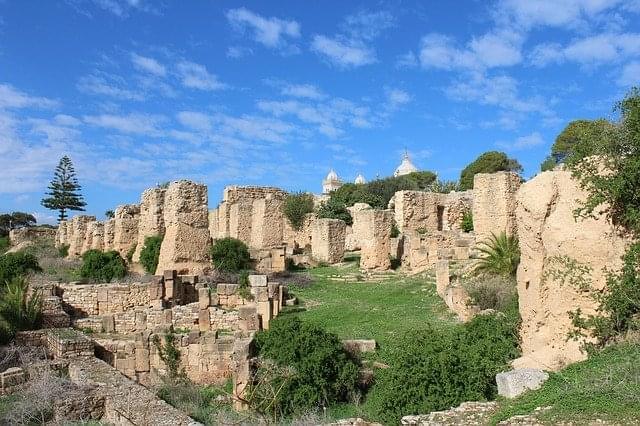 This very important archaeological site is located on the outskirts of the city.
It is a unique place, evoking ancient times and millennia of history.
The site is very large and half a day is the minimum necessary to visit at least the main attractions, but if you want to do things properly and visit everything, including the museums, calmly and without rushing, a full day is perfect.
Themain stops are: the Amphitheatre, the Roman Villas, the Roman Theatre, the Early Christian Museum, the Museum of Carthage, the Tofet of Salambo, the Baths of Antoninus and the Magon Quarter.
-
Distance: 16.5 km
-
How to get there: TGM train from Tunis Marin (33 minutes, €0.30), bus No 20 leaves from the roundabout near Tunis Marine (Place de la République - 40 minutes, €0.50), taxi (15 minutes, €2.50) - Get directions
-
Hours: in winter 8:30am-3pm, in summer 8am-6pm
-
Ticket price: €4.50 + €1.00 photography fee
-
Card, tickets and recommended tours : Carthage and Sidi Bou Said: half-day tour from Tunis
2 - Sidi Bou Said
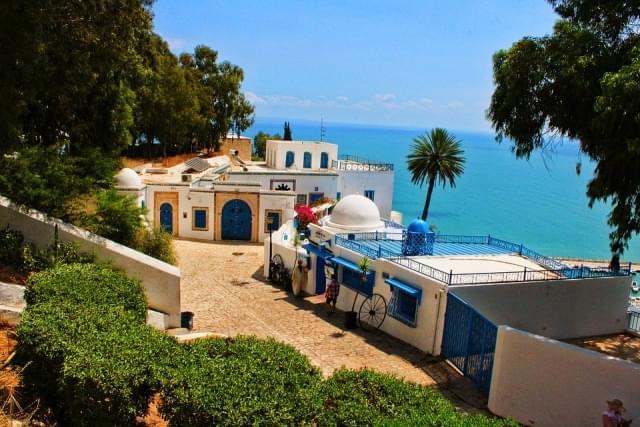 This village is perched on a promontory overlooking the Gulf of Tunis and for this reason has earned the nickname'Balcony of the Mediterranean'.
The distinguishing feature of this place is the predominance of white and blue hues: the houses are iridescent white (to keep them cool in summer and to keep mosquitoes away) and blue doors, gates and shutters stand out on the façades. A fantastic sight made even more dazzling by lush bougainvillea bushes!
Over the years, the village has always attracted many artists, especially the avant-gardists of the early 20th century. The Café des Nattes, a famous café on top of a small hill at the end of the main street, is proof of this.
While sipping a mint tea with pine nuts, you can observe the furnishings of yesteryear and the yellowed photos on the walls that bear witness to the passage of the likes of Paul Klee, Simone de Beauvoir, André Gide and Jean Paul Sartre.
-
Distance: 17.7 km
-
How to get there: TGM train from Tunis Marine (37 minutes, €0.30), bus no. 20 leaves from the roundabout near Tunis Marine, Place de la République (40 minutes, €0.50), taxi (20 minutes, €3.00) - Get directions
-
Hours: always accessible
-
Ticket price: free
-
Card, tickets and recommended tours : Carthage and Sidi Bou Said: half-day tour from Tunis
3 - El Jem
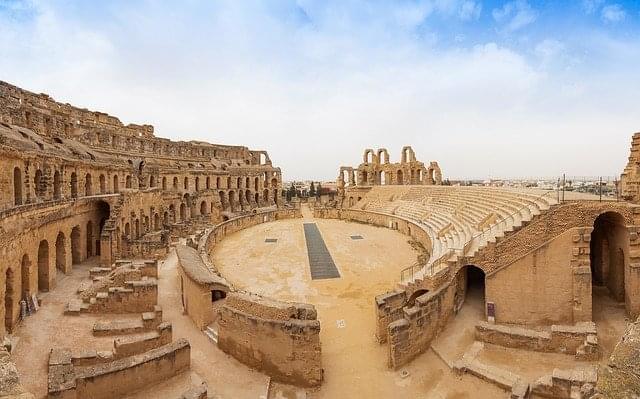 ThisRoman amphitheatre, elliptical in shape, is 149 m long, 124 m wide and 36 m high. The space could accommodate up to 30,000 spectators.
These measurements rank theAmphitheatre of El Jem as the 7th largest, after Rome, Capua, Milan, Autun, Verona and Carthage.
Its round and massive silhouette stands on a flat plain in the middle of the desert, which allows it to be seen from a very long distance.
It is also one of the few best-preserved structures despite the many vicissitudes it has suffered over time, one above all, the cannonballs with which it was bombarded at the end of the 17th century to remove a rebel tribe that had entrenched itself there and which caused a large breach.
Not only a historical monument, it is used as a cultural venue for the El Jem Symphonic Music Festival and other artistic events.
-
Distance: 207 km
-
How to get there: train 5/53 direction Gabes to take in Tunis Gare Centrale (Place de Barcelone) (2h 45 min, €4.00), taxi (2h 10 min, €20.00) - Get directions
-
Hours: 8am-6.30pm
-
Ticket price: €4.00
-
Card, tickets and recommended tours: From Tunis: Organised tour to Kairouan and El Jem
4 - Kairouan
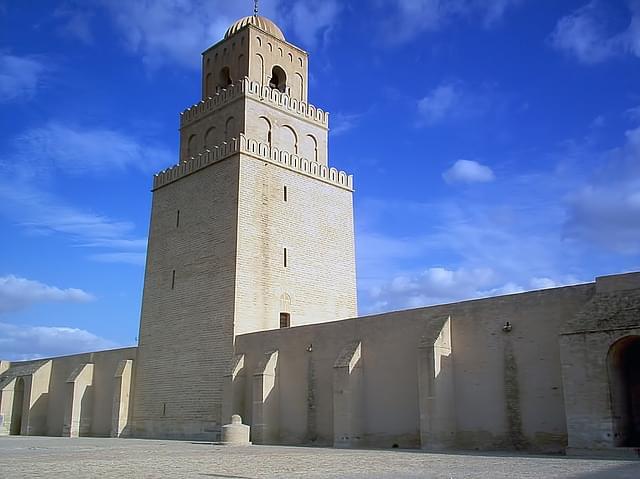 It isthe fourth holy city for the Islamic world after Mecca, La Medina and Jerusalem. This fascinating city is far from the coast, and is characteristic for its location in the middle of a steppe landscape.
It was the first capital of the Maghreb. Listed by Unesco as a World Heritage site, it has many wonders: the medina, the Great Mosque, the Aghlabid Basins, the enchanting mausoleum of Sidi Saheb.
Non-Muslims can enter the courtyard of the Great Mosque and see the majestic prayer hall; if they wish, they can also climb the minaret, inspired by the lighthouse of Alexandria.
Another important monument is the graceful zaouia Sidi Saheb ('Barber's Mosque'), covered in colourful ceramics. The Raqqada Museum is interesting, where pottery, gold coins and pages from the Koran are kept.
Other magnificent experiences not to be missed are strolling through the alleyways of the Medina, climbing the crenellated ramparts surrounding the old city, visiting the Barrouta well, which is very old and revered in popular belief.
-
Distance: 161 km
-
How to get there: bus to Oueslatia departing from Place de la République (2h 40 min, €3.00), taxi (3 hrs, €26.00) - Get directions
-
Hours: mosque: 8am-2pm. Closed Fridays
-
Ticket price: the mosque €4.00
-
Card, tickets and recommended tours: From Tunis: Organised tour to Kairouan and El Jem
5 - Sousse and Monastir
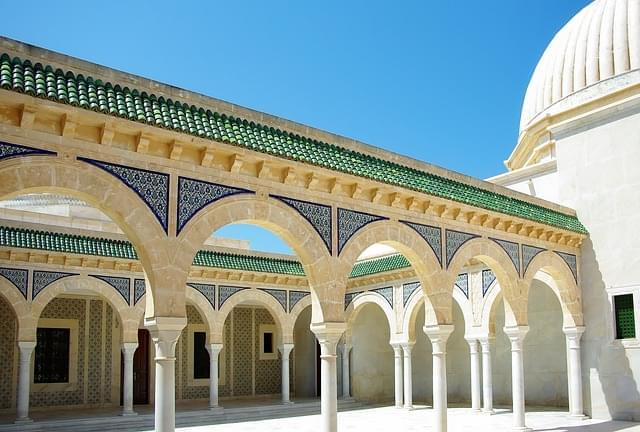 Sousse is a town founded by the Phoenicians which preserves monuments of rare beauty.
It boasts a Medina that has become a Unesco World Heritage Site and its port has been of strategic importance since the dawn of time. Indeed, important trade exchanges used to pass through here to trade in spices, textiles and typical products.
The Medina is dominated by the Khalef Tower, while in the old city there are monuments such as the Ribat, a fortress and religious retreat, the Great Mosque reminiscent of a minimalist fortress and the Kasbah. History lovers can learn more about the country at the Sousse Archaeological Museum, which houses important mosaics.
Not far from here, we find Monastirwith its long, golden sandy beaches. In addition to the beach life, Monastir also offers interesting monuments: the beautiful Harthema Fortress, the Medina, the Islamic Museum and the Bourguiba Mausoleum built in 1963, identifiable by 3 domes (2 green and 1 golden) and 2 minarets marking the entrance where Habib Bourguiba, the first President of Tunisia, is buried.
-
Distance: 150 km
-
How to get there: train 5-22 towards Mahdia to take in Tunis Gare Centrale (Place de Barcelone - 2h 25 min, €4.00), taxi (2 h, €26.00) - Get directions
-
Hours: always accessible
-
Ticket price: free
-
Card, tickets and recommended tours: From Tunis: Sousse and Monastir sightseeing tour
6 - Dougga
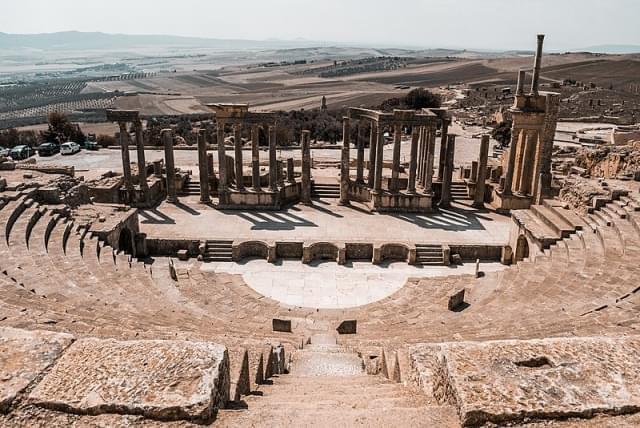 Photo by Monaam Ben Fredj. Just over an hour from Tunis and immersed in the countryside, ancient Thugga is considered the best-preserved ancient city in all of North Africa. It still retains numerous remains of monuments from Punic, Numidian and Roman times, making it one of the most important UNESCO archaeological sites.
The coexistence of Romans and Numids is clearly visible. In fact, this Roman city does not have a geometric layout and has narrow streets reminiscent of a medina.
Walking through these narrow streets, one comes across great monuments such as the Capitol, the temples of Saturn and Juno Celeste, the forum, the theatre, the villa and many others.
The Capitol, surely the most important monument in the city, is a Roman temple dedicated to Jupiter, Juno and Minerva. It was elevated on a high podium and was preceded by a platform where the faithful gathered in prayer for the great ceremonies.
-
Distance: 112 km
-
How to get there: bus to Jendouba patenza from Place de la Republique (2h 50 min, €4.00), taxi (1h 30 min, €18.00) - Get directions
-
Hours: 15 September to 30 April 8:30am-5pm; 1 May to 16 September 8am-7pm
-
Ticket price: €2.50
7 - Hammamet
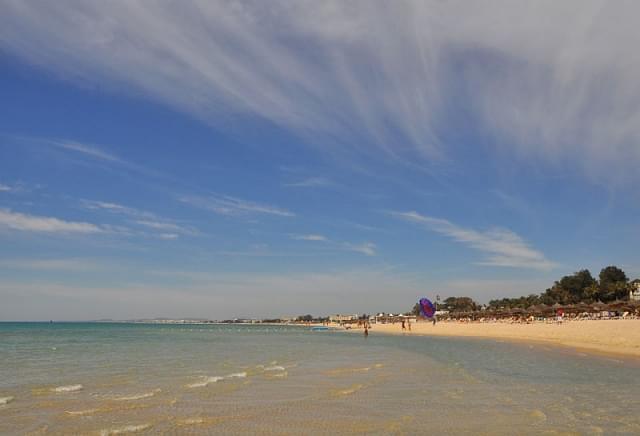 Photo by MJJR. The city isideal for enjoying some sun and relaxation, with its white beaches and turquoise sea that characterise the coastline of northern Tunisia.
The charm of the city comes from the old town, its splendid Medina, which is among the most beautiful in Tunisia.
Among the main attractions is the Dar Sebastian International Cultural Centre built in 1920. The building is a perfect symbiosis of Art Deco and local architecture.
Flamboyant and scenic, today it is home to an open-air theatre.
The city's name derives from hammam, meaning thermal bath: in fact, the waters that flow from the springs have therapeutic and regenerating properties for body and spirit.
-
Distance: 64.7 km
-
How to get there: bus no. 35 from Place de la République (2h 45 min, €3.00), taxi (50 min, €13.00) - Get directions
-
Hours: always
-
Ticket price: free
8 - Bizerte and Lake
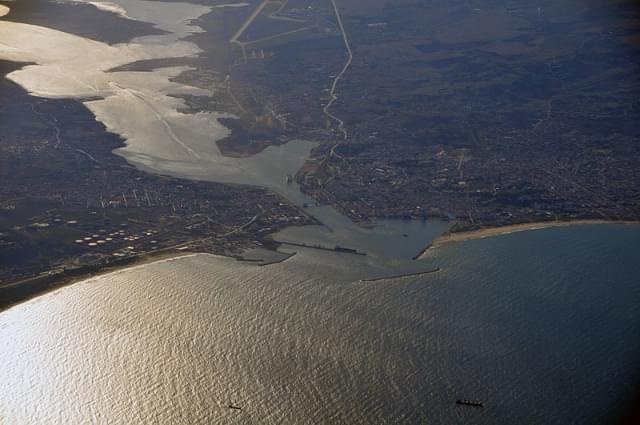 Photo by T A. Situated between the sea and the lake, this city retains the remnants of a tumultuous history since Phoenician times.
A friendly town that allows you to enjoy the advantages and conveniences of a modern city but, at the same time, has maintained traditions in its most picturesque neighbourhoods.
Not to be missed is a visit to the Kasbah, surrounded by mighty fortification walls within which a labyrinthine maze of alleyways unfolds and where you will also find the Ksiba, a small fortress now used as an oceanographic museum.
Also recommended is a tour of the souk and a visit to the Great Mosque. The old port area is very picturesque with colourful boats gliding alongside the walls of the Medina.
Thirty-five kilometres from Bizerte is the nature reserve of Lake Ichkeul, a Unesco World Heritage Site. It is reached via the RN 11 road, heading south-west towards Mateur; after crossing Tinja, the road cuts across the railway. The entrance is 50 m to the right.
The park is a paradise for birdwatchers. You can enter free of charge and walk around the park. Camping is not permitted.
-
Distance: 70.7 km
-
How to get there: bus no. 35 from Place de la République (1h 30 min, €2.00), train from Tunis Ville (4 stops, 1h 50 min, €3.00), taxi (45 min, €12.00) - Get directions
-
Hours: always
-
Ticket price: also free parking at the nature reserve
9 - Ichkeul National Park
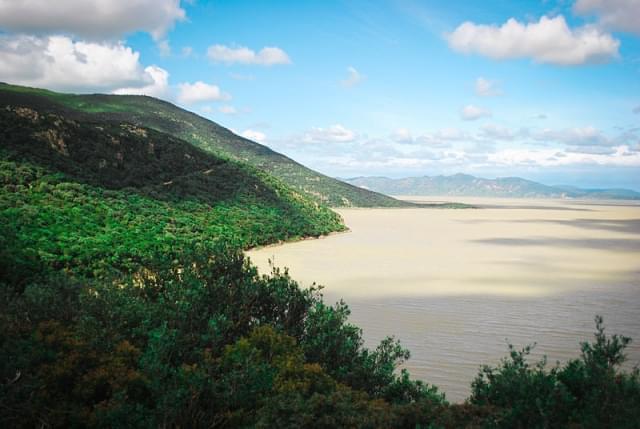 Photo by Mokdad.nysrine. This park is a protected area in northern Tunisia that includes the lake of the same name and the wetlands that surround it.
Covering a rectangular area of 11.4 by 20 kilometres, the park lies around Lake Ichkeul, near the shores of the Mediterranean Sea, whose peculiarity is that it is fed by six freshwater wadis in winter and is connected to the Mediterranean via Lake Bizerte in summer.
It has been abiosphere reserve since 1977 and a World Heritage Site since 1980.
Lake Ichkeul and the surrounding marshes are an important landing place for hundreds of thousands of migratory birds each year: over 200,000 birds from Europe. Ducks, geese, storks and pink flamingos can be seen. There is also a small number of water buffalos, Tunisia's largest mammal, now endangered.
To get there, once through Tinja the road cuts across the railway, the entrance is 50 m to the right.
You enter free of charge and walk around on your own. For guided tours, it is necessary to purchase a tour that includes other destinations in the north.
-
Distance: 85 km
-
How to get there: bus no. 35 from Place de la République with change at Bizerta (2h 10 min, €8.00), taxi (1h 15 min, €14.00), train from Tunis Ville (change at Tunjie, 2 hrs, €5.00) - Get directions
-
Hours: always
-
Ticket cost: free entry also allowed
10 - Experience the Sahara Desert
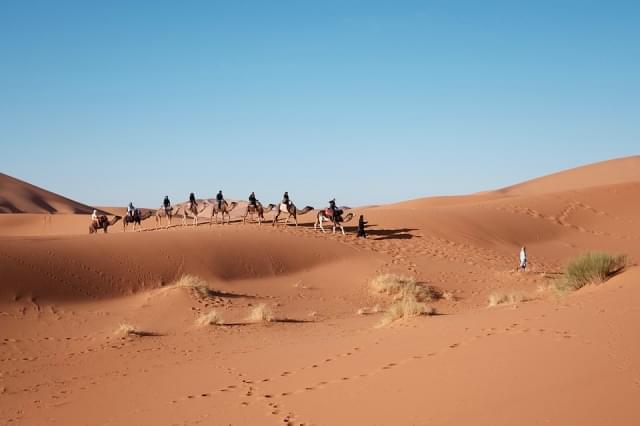 In the southernmost regions of the country, it is possible to go deep into the desert.
One day will certainly not be enough and theexcursion requires at least one overnight stay.
Our advice is to hire a tour, which includes pick-up from your hotel, overnight stays and transport.
The tours usually begin in Douz, Tunisia's oldest oasis, also known as the'gateway to the desert' due to its location at the edge of the Sahara Desert. This is where the camel ride starts and lasts for all three days with delicious lunch breaks and nights in tents under star-filled skies. A unique experience to experience the desert and enjoy the magnificent views - book the tour online
-
How to get there: bus no. 35 from Place de la République with change at Bizerte (2h 10 min, €8.00), taxi (1h 15 min, €14.00), train from Tunis Ville (change at Tunjie, 2 hrs, €5.00)
-
Hours: always
-
Ticket price: tours start at €200.00 per person - book online