Bavaria's most beautiful towns at a glance
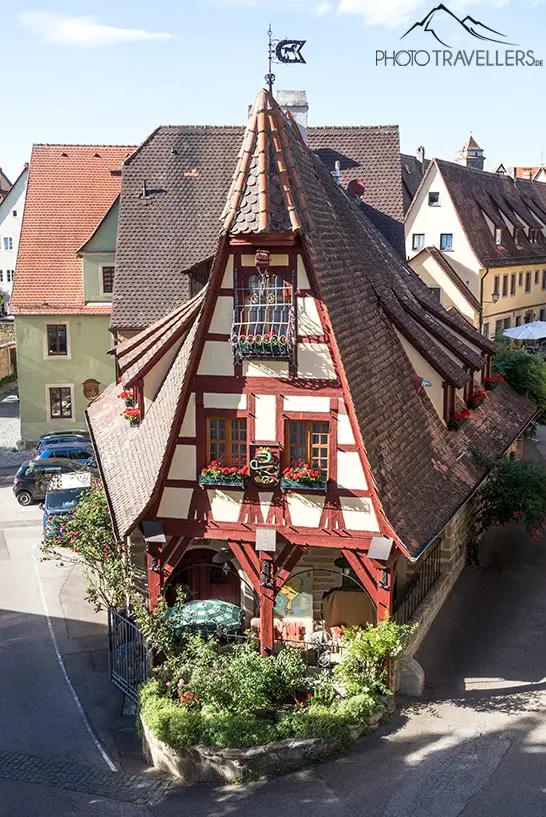 A historic half-timbered house in Rothenburg ob der Tauber, one of the most beautiful towns in Bavaria
Bamberg
Rothenburg ob der Tauber
Passau
Regensburg
Lindau
Nuremberg
Augsburg
Ingolstadt
Landshut
Munich
Würzburg
Dinkelsbühl
Coburg
Map with the most beautiful cities in Bavaria
On our interactive map you will find an overview of the most beautiful cities in Bavaria:
1. Bamberg
One of the most beautiful cities in Bavaria is located in Upper Franconia. Bamberg - also one of the most beautiful half-timbered towns in Germany - was built on seven hills. Probably for this reason, and because of its many churches, the town is also known as "Franconian Rome".
 The old town hall in Bamberg is a frequently photographed motif.
The historic old town is a UNESCO World Heritage Site and contains many beautiful buildings whose origins can be traced back to the 11th century. The old streets and urban structure are also still excellently recognisable, which is why the city centre is considered one of the most beautiful late-medieval city centres in Germany.
A special highlight is the Old Town Hall with its traditional half-timbering and façade paintings. It is located on an island in the Regnitz River and can be reached via two arched bridges. If you look closely, you will see a funny detail on the façade: the leg of a small angel figure sticking out of the painting.
Tip: Don't miss out on Bamberg beer, because the city is famous for its art of brewing. And the best view of Bamberg is from the tower of Altenburg Castle, which you can reach on foot in about half an hour. You can find more information about this in the article about the most important sights in Bamberg! We recommend the Welcome Hotel Residenzschloss.
2 Rothenburg ob der Tauber
Rothenburg ob der Tauber is one of the most beautiful small towns in Bavaria. The former imperial city is known for its medieval town centre, which is extremely well preserved. This is not least due to the fact that the town hardly developed after the Thirty Years' War and there was no railway connection until the 19th century.
 The Plönlein is the top sight in Rothenburg
During the Second World War, large parts of Rothenburg were destroyed, but they were simply and inconspicuously rebuilt and integrated into the old townscape. Thus, not only the cobbled streets and half-timbered houses were preserved, but also the walkable town walls and the medieval town hall.
Rothenburg ob der Tauber is also known for several museums, for example the Kriminalmuseum, the RothenburgMuseum or the Handwerkerhaus. The Käthe Wohlfahrt Christmas Museum is also a very special highlight - either as a gag in the middle of summer or in combination with the lovely Christmas market.
We'll tell you more about this sweet little town in our top sights in Rothenburg. Here you will also find an overview of the most beautiful half-timbered towns in Germany, including Rothenburg ob der Tauber.
Insider tip: The Glocke Winery in Rothenburg ob der Tauber is the southernmost winery in Franconia and offers not only wine tours and tastings as well as its own restaurant, but also accommodation in its own hotel.
3 Passau
 Passau lies on a peninsula surrounded by the Inn and Danube rivers.
The easternmost destination on this list lies on the border with Austria and is called Passau. The city on the three rivers - where the Danube, Inn and Ilz flow together - is also known as the "Bavarian Venice", as its narrow streets and a history shaped by Italian master builders make for real southern charm.
Even before a Roman fort was built on the site of today's cathedral, however, the Celts settled in Passau. The first Celtic settlement was on the old town hill, where the old town hall stands today.
St. Stephen's Cathedral with its characteristic onion domes and impressive organ is also located in the historic city centre, as are many other baroque buildings.
High above the beautiful city sits a 13th-century fortress, the Veste Oberhaus. It houses the Oberhaus Museum and an observation tower.
Tip: Passau is also located on the edge of the Bavarian Forest, which is ideal for excursions and hiking tours. How about the Goldsteig, for example - the long-distance hiking trail is one of the most beautiful multi-day hikes in Germany. By the way, one of the best places to stay in the city is the Hotel Residenz Passau.
4 Regensburg
We return to the Danube once more, because this is also where Regensburg is located. The first traces of settlement date back to around 5000 BC - and the Regensburg Danube bend has even been inhabited since the Stone Age.
 This is a view of the Steinerne Brücke (Stone Bridge) and the cathedral from the Jahninsel.
In 179, a Roman camp was built in Regensburg, called Castra Regina. In the Middle Ages, Regensburg developed from a Roman fort into a bishop's see and later into a free city and imperial city. An impressive relic of antiquity is, for example, the Porta Praetoria, the former main gate of the camp.
You will find other exciting sights in the historic old town, which together with the Stadtamhof district has been a UNESCO World Heritage Site since 2006. Highlights include the Stone Bridge and the Gothic cathedral as well as numerous patrician towers. Find out more about them at the top sights in Regensburg!
Tip: Just outside Regensburg you'll find two other important monuments: the Walhalla, which honours important German personalities, and the Befreiungshalle in Kelheim, which commemorates the battles won against Napoleon during the wars of liberation.
5 Lindau
My fifth highlight takes me to Lake Constance. More precisely, to the eastern shore in the border triangle of Germany, Austria and Switzerland. Here lies Lindau, a unique town that juts into Lake Constance on an island .
 Lindau harbour at sunset
The first traces of settlement, however, can be found on the mainland opposite the old island town. There, an ancient Roman villa from the second century AD was uncovered, the foundation walls of which are now in the Roman Park.
Lindau was later a free imperial city until 1803. In the 15th century, an imperial diet was even held here. Incidentally, the magnificent town hall, which like the entirehistoric old town is a listed building, dates from the same period.
More information and insider tips can be found in the article about the top sights in Lindau!
6 Nuremberg
Nuremberg, the second largest city in Bavaria, has much more to offer than the famous Christkindlesmarkt. High above the beautiful city, for example, sits the impressive Kaiserburg on the Felsenberg.
The double complex, whose construction probably began around 1000, also includes the Burggrafenburg. But there is also a lot to discover under the city - here you will find the notorious Lochgefängnisse (hole prisons ) and the underground rock passages.
All these sights are part of the Nuremberg Historical Mile. Also part of this historical tour are, for example, the Schöne Brunnen (Beautiful Fountain) and the Gothic Frauenkirche (Church of Our Lady) on the Hauptmarkt (Main Market Square).
Another exciting destination is the Documentation Centre Nazi Party Rally Grounds, located just outside Nuremberg. This is where the NSDAP held its party rallies from 1933 to 1938. I'll tell you more about it in the article about the top sights in Nuremberg.
7 Augsburg
 The Golden Hall is the highlight of Augsburg's town hall.
Augsburg is also super interesting as one of the oldest cities in Germany. The name goes back to a Roman army camp that was founded as early as 15 BC.
In the 13th or 14th century Augsburg finally became an imperial city, where imperial days were often held. As a result, a lot of money from wealthy merchant families also flowed into the city, especially from the Welsers and Fuggers. This is why Augsburg became the Fuggerstadt - the Fugger houses and the Fuggerei, a social settlement founded by Jakob Fugger in the 16th century, still bear witness to this today.
In the old town you will also find historical buildings from other style periods, such as medieval guild houses, the Cathedral of the Visitation of the Virgin Mary from the 11th century or the Basilica of St. Ulrich and Afra with its onion dome. Augsburg's striking town hall with its Golden Hall dates from the Renaissance.
Here we show you these and other top tourist attractions in Augsburg - including, of course, the Augsburg Puppet Box, which opened its curtain for the first time in 1948.
8 Ingolstadt
 The ensemble of the Old Town Hall, the Pfeifturm and the Moritz Church is a real eye-catcher.
On to Upper Bavaria. Idyllically situated on the Danube is Ingolstadt, Bavaria's fifth-largest city. Traces of the Neolithic period have even been found in some of the suburbs.
Ingolstadt was first mentioned in a document in 806. In the late Middle Ages, the city became the seat of a duke, which can still be seen in its architecture today. Ingolstadt's historic old town is well preserved and is home to impressive buildings such as the Pfeiffturm, the Kreuztor and the old town hall.
Other historical milestones include the year 1472, when Bavaria's first university was founded in Ingolstadt, and the year 1516, when the Purity Law was enacted there. Incidentally, it still ensures the first-class quality of Bavarian beer today!
And another exciting fact about Ingolstadt: the free-thinking Illuminati Order was founded here in 1776.
9 Landshut
You will find many parallels with Ingolstadt in Landshut. The city is also in Bavaria and lies directly on the river Isar. In addition, traces of the late Middle Ages can be seen in the architecture.
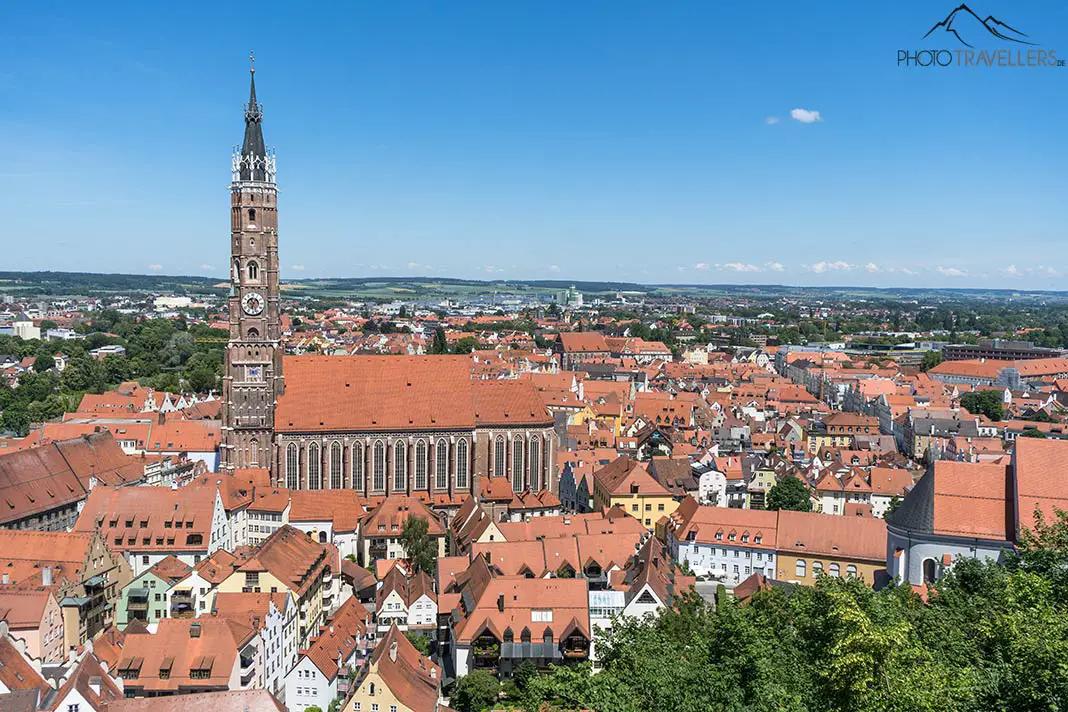 Landshut is simply beautiful - a visit is well worthwhile.
A very important tradition also dates back to the late Middle Ages, the Landshut Wedding. To this day, the town's inhabitants celebrate a medieval festival every three yearsto commemorate the marriage of the Bavarian Duke George the Rich to the Polish king's daughter Hedwig of Burghausen. She made Landshut an important centre at that time.
Landshut was first mentioned around 1150 as "Landeshuata", which stands for "hat and protection of the land". A little later, construction began on the city's landmark - Trausnitz Castle.
It towers high above the historic old town, where you will find sights steeped in history such as the Gothic St. Martin's Church with its brick tower - it is even the highest church tower in the world built of bricks - or the medieval Ländtor. In the old town you'll also find the Stadtresidenz Landshut, one of the first Renaissance buildings north of the Alps.
10 Munich
Of course, almost everyone knows Munich, the capital of Bavaria and one of the largest cities in Germany. But do you know anything about the exciting history behind it?
Munich was first mentioned in a document in 1158 - as "forum apud Munichen". It is assumed that this means "near the monks" and that there was a settlement of monks on the site where the city is today.
However, Munich was only granted market, minting and customs rights when it was first mentioned in a document - it is not known when the city was actually founded. It is known, however, that the oldest and at that time still the only parish church in the city was St. Peter's Church.
In the Middle Ages, Munich then became the seat of the Bavarian dukes and later the imperial residence. The historic metropolis became the capital of the federal state in 1506. The famous Oktoberfest took place for the first time in 1810.
Tip: On our travel blog you will not only find the most important sights in Munich, but also numerous tips and attractions in the city and its surroundings. Just search for the keyword "Munich"!
11 Würzburg
We are nearing the end of the list and stop in beautiful Würzburg. The Lower Franconian city was first mentioned in 704 as "Virteburh". In the Middle Ages it rose to become an important economic, spiritual and sovereign centre.
 The old Main bridge in Würzburg is very beautiful
As a result, an impressive townscape developed in Würzburg, including in particular old buildings in the Baroque and Rococo styles. Unfortunately, only a few townhouse ensembles were rebuilt after devastating bombing raids in the Second World War.
However, most of the churches in the historic old town and the most important individual monuments have been reconstructed, at least externally. These include the famous Würzburg Residenz with the Residenzplatz and the beautiful Hofgarten, which was finally inscribed on the UNESCO World Heritage List in 1981.
Also among the top sights in Würzburg are the Marienberg Fortress and the Old Main Bridge, where you can drink a glass of wine in traditional style. In general, Würzburg is considered the heart of Franconia's wine region - so you'll find not only extensive vineyards and wineries here, but also numerous wine taverns and wine cellars.
12 Dinkelsbühl
Now we come to a small town in Middle Franconia that you may not be familiar with. But you should definitely get to know Dinkelsbühl!
The former imperial city is a popular destination for excursions thanks to its late medieval town centre. It is exceptionally well preserved and has not been changed for 400 years. The city wall and moat that run around the city centre are also in excellent condition.
However, the history of the city goes back much further. As early as the 10th century, an important trading centre was built on the site of Dinkelsbühl, as important trade routes crossed there. Dinkelsbühl was first mentioned in 1188 under the name "burgum tinkelspuhel".
Tip: Dinkelsbühl lies on the Romantic Road, which runs from Würzburg to Füssen and connects impressive towns, regions and sights. Rothenburg ob der Tauber and Augsburg are also on the route.
13 Coburg
As promised, the final topic is the English royal family. Where is it represented in Bavaria? In Coburg!
Although Coburg was first mentioned in a document in 1056, it did not achieve great importance until the 16th century, when it became the residence of the Dukes of Saxe-Coburg - later Saxe-Coburg-Gotha. Probably the most impressive witness to this period is Ehrenburg Palace, the ducal residential palace in Coburg's city centre.
 The market square in Coburg with the Prince Albert statue in the middle and the town hall on the right. A large weekly market is held here on Wednesday and Saturday
The connection with the English royal family comes from the fact that Coburg's Prince Albert married his cousin, the British Queen Victoria, in 1840. And today's monarch Queen Elizabeth II is a great-great-granddaughter of the two!
Even older than Ehrenburg Castle is the town's landmark, the Veste Coburg. It towers high above the town and is one of the largest and best-preserved castles in Germany. It was first mentioned in 1225 and became famous in 1530 at the latest, when Martin Luther stayed there for several months.
In the beautiful old town of Coburg you will also find one of the oldest half-timbered buildings in Germany and the historic market square. Not only is there an annual Samba Festival (the biggest after the Rio Carnival!), but also one of the most beautiful Christmas markets in Franconia. I'll tell you more about it in the top sights in Coburg.
Facts and figures about Bavaria and its cities
Here are the most exciting historical places in all of Germany
In Bavaria alone, there are more than 200 towns with historic city centres
Schwanfeld in Bavaria is considered the oldest village in Germany - people lived and worked here as long as 7500 years ago.
The remains of a hitherto unknown human ancestor, who must have lived around 12 million years ago, have also been discovered in Bavaria.
Here you will find all the tips and recommendations for your holiday in Bavaria.
We have also summarised the most beautiful small towns in Bavaria for you