Sightseeing in Tokyo, Japan
 Tokyo has so many sights that you will need several weeks alone to see all the highlights. You can wander around modern museums, traditional temples and enchanting parks. You can visit the capital of Japan from a great height from one of the viewpoints. Tokyo has remnants of its imperial past and busy neighbourhoods that feel like you're in the middle of a game.
Earthquakes and World War II destroyed many monuments, but fortunately most have been rebuilt to their full glory. Efficient public transport makes it easy to reach almost all of Tokyo's sights. It can be hard to choose if you are short on time, so perhaps planning is not a crazy idea if you want to see the highlights. Visiting the Japanese capital? Find the best sights in Tokyo here.
Major museums in Tokyo
 Tokyo is the largest city in the world, so it's no surprise that you'll find many museums. Tokyo is home to some renowned world-class museums, with rich collections in art, culture and history.
Tsukiji Fish Market
 The huge Tsukiji Fish Market, which has been around since the 16th century, is one of the sights not to be missed while on holiday in Tokyo. It is an ideal outing if you are still suffering from jet lag.
Imperial Palace
 The Imperial Palace is a protected piece of greenery in densely populated and densely built-up Tokyo. The palace is set in a beautiful seventeenth-century park surrounded by moats and two-metre-thick walls. It was built on the same spot where Edo Castle first stood, the power base of Japan's rulers until 1868.
Tokyo Skytree
 The Tokyo Skytree is the tallest tower in Japan and the second-highest structure in the world. The steel television tower - which is shaped like a tree - has a height of no less than 634 metres. At 350 metres, there is a viewing platform.
Senso-ji Temple
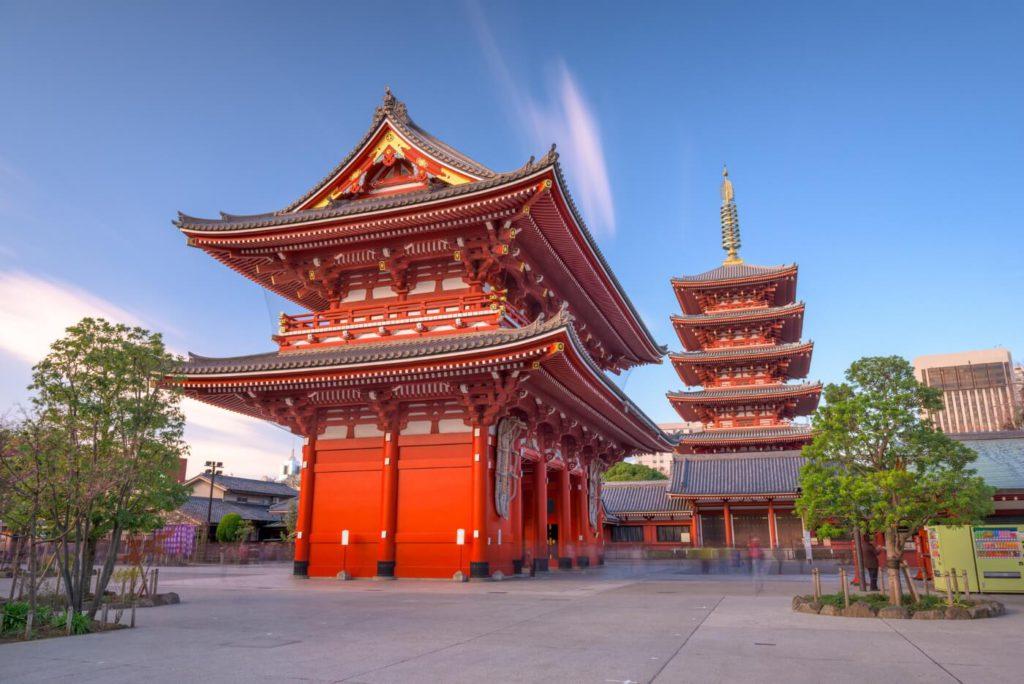
 The Senso-ji is Tokyo's oldest temple, said to have been built as early as 628. According to a legend, the temple was built when two fishermen, Hinokuma Hamanari and his brother Takenari, fished a statue of the Buddhist goddess Kannon out of the river.
Shibuya intersection
 People crossing do not easily constitute an attraction, but the Shibuya inters ection is definitely worth a visit during a holiday in Tokyo. This is the busiest intersection in the world, with as many as 3,000 people crossing the pedestrian crossings at the same time at peak times!
Tokyo Tower
Tokyo has its own version of the Eiffel Tower, but in red. Indeed, Paris' most famous symbol served as the model for Tokyo Tower, a communications tower built in 1958. The tower served as a symbol of Japan's post-war rebirth as an economic power. At 333 metres, the Tokyo Tower is even taller than the original Eiffel Tower, but still nowhere near as tall as the Tokyo Skytree. However, it is still the tallest steel tower in the world.

There is an observation platform at 150 metres and at 250 metres(Top Deck), where you can get a great view of the Japanese capital. You can get to the first observation deck by lift or stairs (600 steps). There is also a café and souvenir shop on the first floor. On the ground floor is an indoor amusement park, One Piece Tower(www.onepiecetower.tokyo), with attractions based around popular Japanese manga comics. Address: 4 Chome-2-8 Shibakoen, Minato, Tokyo 105-0011, Japan. Website: www.tokyotower.co.jp
Meiji Shrine
The Meiji Sh rine(Meiji Jingū) is one of Tokyo's most important religious sites, and less old than you might expect. Construction of the magnificent Meiji Shrine began in 1915 and was completed in 1926. The shrine is dedicated to Japanese Emperor Meiji (1852-1912) and his wife Empress Shōken. Meiji was the first emperor of modern Japan to connect with the West and rapidly industrialise the country.

During World War II, the Meiji Shrine was largely destroyed but rebuilt in 1958. Near the shrine is a museum(Meiji Jingu Treasure House) with personal effects and royal treasures of the emperor and empress. All around is a forest with 120,000 trees of all species found in Japan. In this forest, you can take leisurely walks and escape the hustle and bustle of Tokyo for a while. The entrance to the shrine is a stone's throw from Harajuku Station. Address: 1-1 Yoyogikamizonocho, Shibuya City, Tokyo 151-8557, Japan. Website: www.meijijingu.or.jp
Shinjuku Gyoen National Garden
The most popular place to relax in Tokyo is Shinjuku Gyoen National Garden, a large 144-hectare park that was the residence of a Japanese warlord for almost 300 years. It was opened to the public in 1949. Shinjuku Gyoen has gardens, forests, a large and picturesque pond and hundreds of cherry trees that are a crowd pleaser in early April due to their cherry blossom.

More than 20,000 trees from all over the world grow there and between the treetops you can see Tokyo's skyscrapers. The park is also fun to visit in autumn, when the leaves change colour. The park has a French formal garden, an English landscape garden, a traditional Japanese garden and a Taiwanese pavilion. Shinjuku Gyoen is just a short walk away from the busy Shinjuku Station, but after paying the modest entrance fee, you soon notice that the noise of the city fades away. Address: 11 Naitomachi, Shinjuku City, Tokyo 160-0014, Japan. Website: www.env.go.jp
Nezu Museum
The Nezu Museum is a stunning museum that combines traditional art with contemporary architecture. It is housed in a serene building with large glass walls designed by renowned Japanese architect Kengo Kuma in 2009. A long covered outdoor walkway with bamboo acts as a minimalist entrance. Inside, you will see a collection of 7400 pre-modern artworks from Japan and East Asia collected by industrialist Kaichiro Nezu (1860-1940), president of the Tobu railway.

The works in the permanent collection include calligraphy, paintings, ceramics and textiles, with a strong focus on Buddhist art. There is an exhibition about seven times a year, with a different theme each time. Perhaps the highlight of the Nezu Museum is its vast Japanese landscape garden with ponds, streams, sculptures and walkways. In the garden is a quaint teahouse where you can have lunch and tea or coffee. The museum is closed on Mondays. Address: 6 Chome-5-1 Minamiaoyama, Minato City, Tokyo 107-0062, Japan. Website: www.nezu-muse.or.jp
Okura Museum of Art

The Okura Museum of Art is Japan's first private museum, founded in 1917 by entrepreneur and arms dealer Kihachiro Okura (whose son, incidentally, introduced the automobile to Japan). He collected Japanese and East Asian art, partly to prevent important works from disappearing abroad. The museum and part of the collection were destroyed in a major earthquake in 1923, but in the following years Okura purchased new works of art and reopened the museum in 1928.
Some 2,500 works are on display, including paintings, sculptures, ceramics, swords, calligraphy and textiles. Located opposite the famous Okura Hotel in Tokyo, the Okura Museum of Art is indeed part of the Japanese hotel chain. If you are planning a visit and looking for accommodations, you can explore a variety of options at Tokyo hotels at tophotels.com or check offers at http://www.tokyo-hotels-stay.com/en/. One of the commendable options around the area is the Keikyu Ex Hotel Shinagawa.
Admission to the museum is free for hotel guests. Address: 2 Chome-10-3 Toranomon, Minato, Tokyo.
Tokyo Disneyland
One of the most popular attractions for children is - how could it be otherwise - Tokyo Disneyland. The theme park opened in 1983, making it the first Disneyland outside the United States. Resembling its US counterparts in Florida and California, the park has seven themed areas with a combined total of more than 40 attractions.

For example, Tomorrowland is home to popular attractions such as Space Mountain, Star Tours and Buzz Lightyear's AstroBlasters. Fantasyland is inspired by classic Disney films, with famous Cinderella's castle at its centre. Two attractions are unique to Disneyland: Pooh's Hunny Hunt and Monster's Inc. Ride & Go Seek (where you ride in a tram past funny, hidden monsters). Consequently, there are always long queues here.
It's best to buy tickets for Disneyland Tokyo online. If you go to the ticket office at the entrance on the day itself, tickets may be sold out. The theme park is located in the east of the city, quite far from the centre of Tokyo. You can take the train from Tokyo Station to Maihama Station, a 15-minute ride. From the station, you can walk to the entrance. Address: 1-1 Maihama, Urayasu, Chiba 279-0031, Japan. Website: www.tokyodisneyresort.jp
Flying to Tokyo
 From the Netherlands, you can easily fly to Tokyo. KLM flies once or twice a day directly from Amsterdam Schiphol Airport to Japan's capital. The flight time is about 11 hours. You can also fly to Tokyo with a transfer.
Public transport in Tokyo
 Tokyo has an extensive and intense public transport network with subways, trains and buses operated by a dozen different transport companies. At first glance, seeing all the lines on a map dizzies you. Soon you will get used to Tokyo's public transport system.
Places to stay in Tokyo
 Choosing where to stay in Tokyo is hard: there are endless accommodation options in Japan's capital city. You can stay in luxury hotels, cheaper business hotels, homely ryokans, hostels and capsule hotels during your holiday.
Visiting Mount Fuji
 From Tokyo, you can easily visit Mount Fuji, Japan's highest mountain that has inspired painters, writers, and poets for centuries. You can even see the 3776-metre-high volcano from the Japanese capital on clear days.